Running a 52-34 on Shimano DI2 11 Speed

As part of some upgrades from Ultegra 8050 / 8070 to Dura Ace 9150 / 9170, I’ll be trying out a 52-34 (typically you would use 52-36 subcompact or 50-34 compact) gearing. I replaced the 50t chainring on my Shimano 105 R7000 160mm crankset, with a lighter 52t Ultegra one.

This setup is not officially recommended due to loss in potential shifting quality, but I’ve read enough to feel it won’t be an issue, especially with DI2. The benefits of doing this is I’ll gain higher top-end speed with the 52t, most useful on descents, while still retaining the same climbing capabilities with the 34t. I decided to swap out my 11-34 cassette with a 11-28 as I mainly ride on flats now and the condensed gearing will allow to me to have smaller jumps between cogs. I’ll be able to switch back to an 11-34 when necessary, for specific events with a lot of climbing.

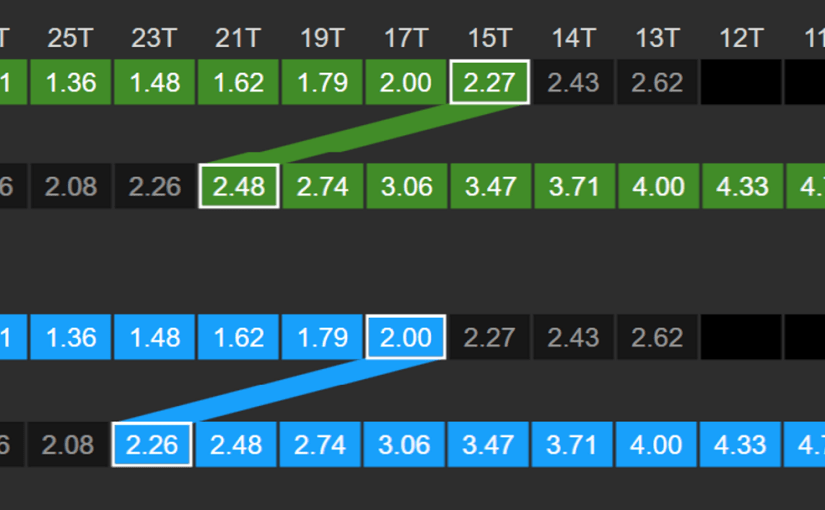
I’ve adjusted my DI2 synchro shift accordingly, and will be using 15 gears.

The Worst 2nd Place Zwift Race Result Ever

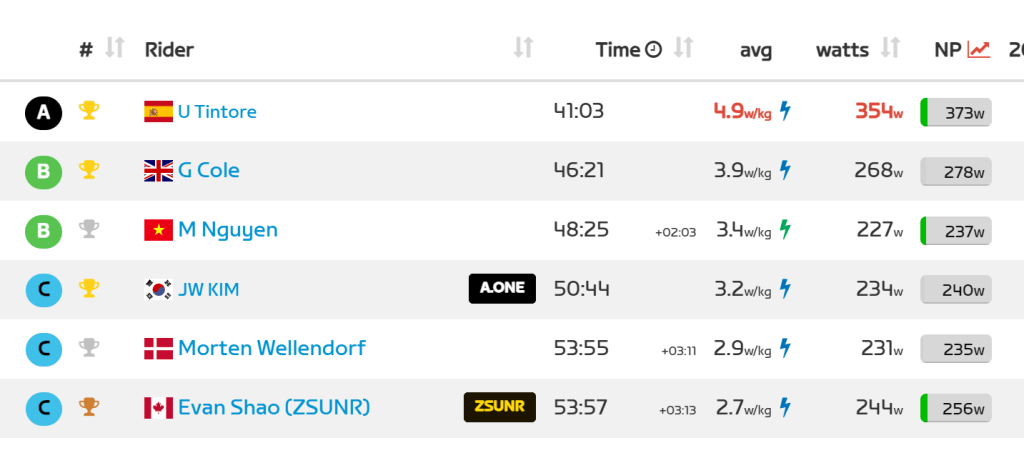
3 years ago, I finished third on a Zwift group ride. Yes, it was a group ride and not a race, but nearly 200 people participated so I felt it was a good result. I never did so well again until a few days ago.

I finished 2nd place in my group (B), 3rd overall in a field of 20. I should be thrilled, but ZwiftPower only recognized 6 total competitors and in my group I finished last. Thus I didn’t even get positive ranking points.

So still waiting on my first true podium finish and good result.

Going for the 1 Hour mark at the 2024 Mt. Diablo Challenge

A couple of weeks ago, I raced the Mt. Diablo Challenge for the first time. I finished:

I finished in the top 27% overall and top 23% in my age group doing 233 watts, about 3.45 w/kg. However, I don’t have any doubt I can finish in one hour with possibly a top ten finish. Before I talk about why, here are my impressions of the event:

  • Mt. Diablo is a well known San Francisco Bay Area Climb. But most of my riding has been in the South Bay (Mountain View to Morgan Hill) and Sacramento. It was my first time riding this famed climb.
  • Driving into the parking lot at 7:30AM reminded me of when car enthusiasts get together to show off their cars. Even though I’ve been to plenty of mass rider events, I felt such a strong concentration of “Wow, that’s a $10K bike! There’s another…and another”
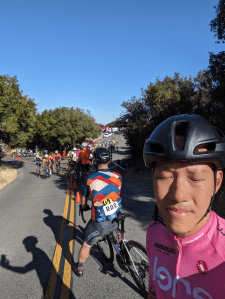
  • The view going up and down was great. I really enjoyed the descent, riding with a hundred other people down the road, just awesome views and a happy feeling traveling with so many people. I don’t do a lot of social riding, and even then I’m not a talker, but just being with so many people not needing to talk fulfilled my togetherness quota for the year. As you near the finish line, those who finished before you are waiting to urge you in the final (super steep) section. That’s me below watching (yes, eyes are closed) the people climb up.

Now here’s why I am confident about achieving the 1 hour mark (you get a special shirt for it too!) next year:

  • I participated in the Sacramento Century (100 miles but less than 1000 feet climbing) the day before. While my IF (intensity factor) was a relatively conservative .64, this turned out to be my highest all time power for the 5hr 10 minute ride. My back was hurting during the ride and my legs were a bit worn even after the night’s sleep. Clearly, I didn’t come in fresh. I thought I’d warm up and feel good after starting the ride, especially with a boost from caffeine, but I felt the effects of the previous day throughout and I started losing a lot of power in the second half of the climb.
  • Why was I silly enough to schedule two events like this back to back? I actually didn’t know they were back to back until about a month prior – I had already been signed up for a few months at that point. I would have preferred to do Mt. Diablo first, but that wasn’t up to me. I decided to keep the century ride because I thought my pace would be casual enough so I’d be ok for the race. I knew there was a risk but I just wanted to keep both events since I’d never done either before.
  • The week before the race I had done 269 watts over 28 minutes on a simulated Zwift climb. People like to say FPT power is the theoretical max 1 hour power someone can produce. If you don’t want to do a hour hour test, they’ll take 95% of a 20 minute test. Using that 28 minute power, my FTP should have been at least 255 watts. My guess is that I am closer to 260 watts. This is BestBikeSplit’s guess for what I could do at that rate. Looking at this year’s results, top ten finishers are right below the one hour mark.

My own tips for next year’s race:

  • I’m not doing 100 miles the day before the event. Complete rest at least 4 days before the event, focusing on good sleep.
  • I didn’t understand the bathroom situation so I waited in a long line where I picked up my packet. A few miles away at the race start, there are plenty of bathrooms. No more stress next time.
  • I’m taking off all my bottle cages and not bringing water. I brought one water bottle this time, but I didn’t need it, and it’s really hard to go all out and drink without losing momentum. I’ll drink during the drive over and then pee at the race start. That’s a saving of at least 1.5 pounds, almost 10% of my bike’s weight.
  • I’m not sure how far I want to go weight weenie, but I could also go with thinner tires. I went with 25mm/32mm front/rear since that’s just my normal setup, but I could see myself going 25mm/25mm just for the mental benefit. I’m curious about this cassette to save another .2 pounds, but I think that’s overkill and I’m worried about its reliability.
  • I am highly dependent on my Halo headband to absorb sweat and like an idiot, I forgot mine in the car. I was already miles away going to the race start when I realized this. Since the morning was cool (around 55F), I didn’t get affected by sweat too much, but it was definitely a mental stress and I did have to handle it a few times. Again, when you’re going full out for an hour, every little distraction can kill momentum.
  • I didn’t use sunglasses to avoid sweat and visibility issues (and a little weight) and that was the right decision. I was good with my clothing choice, and didn’t use gloves.
  • I had two caffeine bars (around 160mg total) but I think one would have been fine as I don’t consume caffeine often. I’ll test this a bit over the next year.
  • Training – I’ll work on 1 hr climbing over the next year and if I’m consistent I think I could gain up to 10 more watts (4% increase) and lose 2kg. The power gain is fairly modest.

1000 Miles: Luke Prescription Cycling Sport Sunglasses from Optical Factor

Seven months ago, I wrote Finally: Cheap Prescription Cycling Sunglasses with Optical Factor, giving early impressions of their Luke Prescription Cycling Sport Sunglasses.

I’ve now used them for about 1K miles, including 12+ hours on the Davis Double Century. Photos from that event during different times of day below. My rides this spring with them have span from 50F to 90F. My takeaways:

  • TLDR: I’d buy them again.
  • They’ve been great. While the Davis Double Century ride was cooler (85F) than in most years, I still felt very hot in spurts during the climbs (close to 9K feet total). I didn’t feel distracted by the glasses despite reduced air flow. This might change as the weather gets warmer and I do more stressful (peak power) climbs. My helmet doesn’t have a good spot for holding the glasses, otherwise I’d take off my glasses during hot climbs.
  • I thought that the outer lenses picked up a lot of scratches but I learned these all came off with lens cleaner. I just applied some and the lenses look brand new again. I’m still using the original wraparound outer lens but the glasses come with multiple replacements of various tints. The glasses do pick up fingerprints / blemishes like crazy – I don’t know how expected this is for Oakleys or other premium cycling glasses.
  • Prescription vision has been great, no headaches or other issues. Again, these were $50 per pair (I bought two).
  • The only area of improvement I’d like is a stopper against the forehead – you can essentially put these glasses into your eyes – this sounds worse than the reality. The glasses don’t really move during riding, sometimes I’ll push them slightly up so they’re covering more of the vertical vision area.