
Growing up as a Warriors fan, I would spend every offseason excited for the next new hope in the NBA Draft. I even got to attend the 1994 NBA Draft in Indianapolis, watching the Warriors pick Clifford Rozier, who was… not good. Typical Warriors of that era.
Fast forward to 2026, and the Warriors have the 11th pick. What should the Warriors do, knowing they have championship aspirations and a Social Security-aged core?
This got me thinking about EV, or expected value. The 11th pick in a deep draft suggests a meaningful player, but historically, is this actually true?
How many players in a draft are actually legitimate winning players? What are your odds of getting one? I started with a suspicion that the Warriors should trade the pick, and that the pick was more hype than value.
The Warriors question is actually a broader draft question. At what point does the expected value of a draft pick fall below the value of a player a team could acquire another way? And at what point is the pick more valuable before it becomes an actual player?
Could we look at this like a financial option, where some of the value disappears once the option is exercised?
A draft pick is like an option. Before it is used, it contains many possible outcomes. After it is used, the market starts pricing one actual player. The hope gets marked to market.
That is the draft pick hope trap.
The question of a draft pick is whether it is more valuable as a player or as an asset. If a player with one real playoff trait and a credible path to scale is available, keep the pick. If the board has collapsed into theoretical upside or replaceable depth, trade the pick while it is still hope.
Working on this framework pushed me toward one question: which prospects already have a trait that can survive playoff basketball?
I used NBA draft history to understand what teams should actually be looking for.
First, let’s answer what should your goal be as a GM in the draft?
The real goal is not drafting an NBA player
The first tier of the draft is about selecting star-level talent. After that, if you are looking to win a championship, I think it is about finding what Draymond Green calls “16-game players.”
These are players who belong in a playoff rotation and can be counted on to help you win a championship through all four rounds.
If you are not one of a good team’s top eight players, you are replaceable. As I will show later, the market already has plenty of ways to find that type of player. You can sign him for the minimum. You can find him in the G League. You can take a swing on a player another team gave up on. You can use the taxpayer midlevel. You can trade for him without giving up a premium asset.
That matters because most draft picks do not become stars. Most do not even become top-eight playoff players by Year 3.
Year 3 is a useful checkpoint because teams usually know whether the player is moving toward core playoff value before the expensive decisions begin.
The draft question becomes more specific:
What are the odds that a pick becomes one of those players?
I am defining a 16-game player as someone who can plausibly be one of the top eight players in a serious playoff rotation by the end of Year 3.
That does not mean he has to be a star. It means he has to survive the playoffs. He has to defend, shoot, process, create, rebound, or protect the rim well enough that a good team does not have to hide him when weaknesses get targeted.
That gives us four tiers:
| Tier | Label | Definition |
|---|---|---|
| 0 | Below top-8 | Not clearly a serious playoff top-eight rotation player by the end of Year 3 |
| 1 | Playoff top-8 | Plausible 6th to 8th man on a serious playoff team |
| 2 | Starter | Plausible top-five player or starter on a playoff team |
| 3 | Premium starter | Borderline All-Star or better, top-three-caliber player on a playoff team |
Most draft analysis treats “he became a rotation player” as a win. I think that is too generous. If the player is outside the playoff top eight, the team can survive without him. It can keep him, churn him, trade him, replace him, or try the next player.
VORP is not the definition of a 16-game player. It is cumulative, regular-season based, and imperfect defensively, but I think it is useful as a rough screen.
I am using 0.5 VORP as a loose reference point. Above that level, a player is at least in the range where we should examine whether he can be a playoff rotation piece.
Does he defend at a playoff level? Does he shoot? Does he make fast decisions? Does he survive matchup targeting? Does he have one specific skill that becomes more valuable in the playoffs?
If not, he is probably replaceable.
To show this, let’s look at some examples.
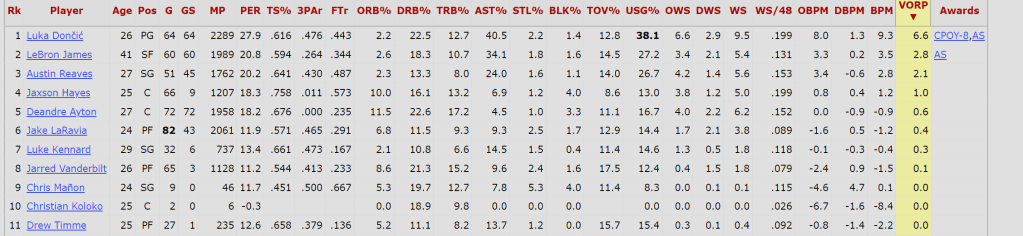
Lakers, 2025-2026: 2nd Round Exit. 5 players. Incredibly top heavy.
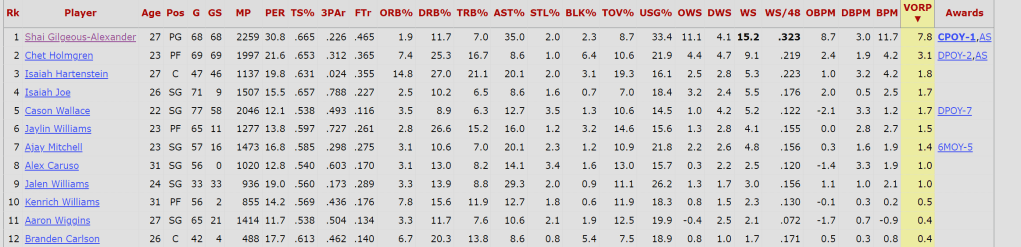
OKC Thunder, 2025-2026: Still playing in the playoffs. 10 Players.
The first statistical pass
I used 10 years of draft history, 2013 through 2022, first round only. That gives ten draft classes and avoids relying too much on incomplete Year 3 playoff evidence from newer classes.
I prefer the last 10 years because it better reflects the YouTube scouting era, where prospects are heavily covered and true information arbitrage is harder.
The individual player classifications are hand-tiered and should be audited. You can view my tiering here on this public Google Sheet.
I used pick ranges instead of specific picks because drafts vary in quality and the sample sizes become too small.
How I classified players
I classified each first-round pick by likely playoff value by the end of Year 3, not by career peak. VORP was only a rough screen. The final question was whether a serious playoff team could plausibly trust that player as one of its top eight. A player could clear the bar through shooting, defense, rim protection, creation, processing, rebounding, or matchup versatility. These tiers are judgment-based, so the percentages should be treated as directional rather than precise.
Here is the result:
| Pick range | Sample | Tier 1: 16-game player | Tier 2: Starter | Tier 3: Premium starter | Tier 0: Replaceable | Median tier |
|---|---|---|---|---|---|---|
| 1 | 10 | 90.0% | 80.0% | 50.0% | 10.0% | 2.5 |
| 2–3 | 20 | 85.0% | 55.0% | 35.0% | 15.0% | 2.0 |
| 4–5 | 20 | 65.0% | 40.0% | 20.0% | 35.0% | 1.0 |
| 6–10 | 50 | 46.0% | 12.0% | 2.0% | 54.0% | 0.0 |
| 11–14 | 40 | 57.5% | 27.5% | 15.0% | 42.5% | 1.0 |
| 15–20 | 60 | 38.3% | 11.7% | 1.7% | 61.7% | 0.0 |
| 21–30 | 100 | 36.0% | 10.0% | 3.0% | 64.0% | 0.0 |
How you can read this: if you had the 11th to 14th pick during the 2013 to 2022 timespan, you had a 57.5% chance of having a winning player (by the end of Year 3), a 27.5% chance of having a starter, and a 15.0% chance of having an upper-tier starter. You were more likely than not to get a 16-game player.
In general, the higher pick you have, the more success you have. This should surprise no one.
What surprised me:
The 6–10 range underperformed the 11–14 range in this first-pass sample.
That led to a hypothesis:
The 6–10 range may be where teams pay top-10 prices for theoretical upside. The 11–14 range may be where teams sometimes find players whose useful traits were discounted for the wrong reasons.
This does not mean picks 11–14 are inherently better than picks 6–10. In this sample, 11–14 produced starter outcomes more than twice as often as 6–10, which is unlikely to be a permanent truth about draft slots but may reveal something about how teams misprice different kinds of upside.
It also produced premium-starter outcomes at a much higher rate, 15.0% compared with 2.0%. Some examples are Tyrese Haliburton, Devin Booker, Donovan Mitchell, Shai Gilgeous-Alexander, Bam Adebayo, Domantas Sabonis, and Jalen Williams.
So what is going on here? And what can we learn from these failures and successes?
Please, NBA GMs: Avoid the Trap
The trap isn’t in falling for upside, it’s falling for fake upside.
Almost every lottery pick has tools. The question is whether the player already has something that works in the NBA, and whether that thing can survive in a playoff setting.
I would use three tests:
- Does his best trait already matter in the NBA?
- Does he have one bankable playoff skill plus one scalable trait?
- Is the upside hidden, or does it require several uncertain things to improve?
1. Do not draft the multi-improvement parlay
“Maybe everything improves” is not a draft strategy.
The mistake is not betting on improvement. The mistake is betting on three improvements before the player has one usable NBA strength.
| Range | Player | What was known pre-draft | What had to improve | Why it fits |
|---|---|---|---|---|
| 6–10 | Stanley Johnson, pick 8 | He had the body teams love: size, strength, wing versatility, and defensive upside. Contemporary reports described him as a huge, physical wing and one of the better defensive prospects in the class. | Shooting, feel, offensive role, and enough skill to stay on the floor. | The defensive tools were real. The trap was assuming the offense would become good enough for the defense to matter in a playoff rotation. |
| 11–14 | Devin Booker, pick 13 | The shooting was already bankable. Pre-draft reports described him as one of the best shooting-stroke prospects in college basketball, with size for a shooting guard and clear off-screen and spot-up value. | Creation growth and defensive survival. | Booker was not just “safe.” He had a bankable NBA skill, youth, touch, and enough size. The league discounted the creation upside because he was mostly seen as a shooter. |
Takeaway: Booker did not hit because he was safer. He hit because his best trait already worked, and that trait gave him a runway to reveal more.
2. Prefer one bankable playoff skill plus one scalable trait
The ideal pick after the top tier is not the highest-ceiling player in the abstract.
It is the player with one skill that gets him on the floor, and one trait that can scale into starter value.
| Range | Player | What was known pre-draft | Bankable skill or trap | Why it fits |
|---|---|---|---|---|
| 6–10 | Killian Hayes, pick 7 | The positive case was size, ball-handling, passing, pick-and-roll feel, and lead-guard projection. | Trap: the passing only mattered if he became a real scorer or advantage creator. | Without scoring pressure, the passing and size package was not enough. |
| 11–14 | Tyrese Haliburton, pick 12 | His useful traits were obvious: size, passing IQ, spot-up shooting, off-ball fit, and low-mistake play. | Bankable skill: decision-making. Scalable trait: processing. | Haliburton did not need to become a different player before his strengths mattered. The league discounted the shot form and creation ceiling too much. |
Takeaway: Hayes needed the scoring to arrive before the rest of the profile mattered. Haliburton’s decision-making already mattered.
3. Hidden upside is already real. Fake upside is imagined conversion.
Hidden upside means the player already has an NBA-relevant trait, but the market is discounting it because the player is older, smaller, weirder, quieter, from a less prestigious program, or harder to fit into a familiar archetype.
Fake upside means the player only becomes good if several uncertain things improve at once: the shot, the feel, the role, the defense, the body, or the decision-making.
That distinction matters because two players can look like “upside” bets on draft night. The difference is whether the upside is attached to something that already works.
The obvious danger is hindsight. After the fact, it is easy to say the hit had hidden upside and the miss had fake upside. That is not good enough.
The test has to be whether the distinction was visible before the draft. Did the player already have an NBA-relevant trait? Did that trait create a path to playoff minutes? Did the upside come from something real, or from assuming several weaknesses would all improve?
This framework will still miss. Some toolsy bets hit. Some skilled players never scale. The goal is not certainty. The goal is avoiding the most expensive mistake: paying lottery prices for a player whose case only works if everything changes.
The lesson is not to “draft safer players,” it’s to find players whose upside is being misread because their best traits are quieter, weirder, older, or harder to categorize.
Donovan Mitchell: messy archetype, real star traits
In 2017, Donovan Mitchell went 13th.
He had real star traits before the draft: burst, strength, defensive pressure, pull-up ability, length, and competitiveness. The market discounted him because he was not the cleanest archetype. He was considered undersized for a shooting guard, and there were questions about whether he could become enough of a lead creator.
Compare that to Frank Ntilikina at 8 and Dennis Smith Jr. at 9.
Their positives were also real. Ntilikina had size, length, and defensive tools. Smith had burst, handle, and athletic creation. The difference was conversion risk. Ntilikina needed the offense to catch up. Smith needed the athletic creation to become efficient, scalable offense. Mitchell’s burst, strength, shooting indicators, and competitiveness were already NBA-relevant.
Lesson: The market can overvalue clean tools and undervalue messy but functional star traits.
Shai Gilgeous-Alexander: quiet skill over loud tools
In 2018, Shai Gilgeous-Alexander went 11th.
He is the cleanest example of hidden upside, not fake upside. The positives were already visible: size, length, pace, craft, defensive playmaking, touch, and shooting indicators. The concern was that he was not explosive, not a clear elite shooter, and not yet a polished lead creator.
Compare that to Mo Bamba at 6 and Kevin Knox at 9.
Bamba had rare length, shot-blocking, and theoretical stretch-big upside. Knox had forward size, athleticism, and scoring flashes. Both had louder tools. SGA’s upside was quieter, but it was already in how he played: pace, processing, length, touch, and craft.
Lesson: Quiet skill can be better upside than loud tools.
Bam Adebayo: playoff skill hiding inside a “tweener” label
In 2017, Bam Adebayo went 14th.
The market saw a strong, explosive big with rebounding and finishing, but not a clean modern offensive role. The positives that mattered were already present: power, vertical athleticism, rebounding, hands, contact finishing, and defensive mobility.
Compare that to Frank Ntilikina at 8, Dennis Smith Jr. at 9, and Zach Collins at 10.
Ntilikina had size and defensive tools. Smith had athletic creation. Collins had size and big-man skill. Each still had to prove the strengths translated into a reliable playoff role.
Bam was discounted because he did not fit cleanly as a modern offensive big. But his real playoff trait was already there: switchable defensive force with power and mobility.
Lesson: Sometimes the market asks the wrong archetype question. Bam was not “what kind of offensive big is this?” He was “can this body, mobility, and strength become a playoff defensive weapon?”
The practical rule
Hidden upside starts with something real. Fake upside starts with a wish list.
After the clear top tier, the goal is not to find the most exciting theoretical player. It is to find the player whose current strengths already create a playoff path.
Why non-top-eight players do not justify the pick
If a player drafted in the first round becomes a top-eight playoff player, the rookie contract is valuable. A real 16-game player on a rookie-scale deal creates surplus value. A starter creates major surplus. A premium starter is the reason teams should still value the draft.
But if the player is not a top-eight playoff player by Year 3, the math changes.
At that point, the salary may still be fine. That is especially true outside the top 10. A late-lottery or mid-first rookie is not usually destroying your cap sheet.
The problem is not only the salary, it’s that you used the pick.
A player outside the playoff top eight is usually the kind of player teams can find another way. Minimum contracts, taxpayer midlevel signings, two-way players, G League development, reclamation projects, veteran specialists, and low-cost trades can all produce 9th to 15th men.
The bar for a first-round pick should not be:
Did he become playable?
The bar should be:
Did he become scarce?
If the answer is no, the team did not gain much. It bought a replaceable player at roughly market price, while spending a draft asset to do it.
In 2025-26, the NBA salary cap is $154.647 million. The taxpayer mid-level exception is $5.685 million. The room mid-level is $8.781 million. The non-taxpayer mid-level is $14.104 million. Those numbers are useful because they show the price range for players teams can acquire without using a premium draft asset.
A rough market ladder looks like this:
| Player type | Market value | What it means |
|---|---|---|
| 11th or 12th man | Minimum to low exception | Replaceable depth |
| 9th or 10th man | Minimum to taxpayer mid-level | Useful, but not core |
| Fringe 8th man or matchup specialist | Taxpayer mid-level to room mid-level | Sometimes playoff-useful |
| Real 7th or 8th man | Room mid-level to full mid-level | Actual 16-game player |
| Starter | Above full mid-level | Scarce player |
| Premium starter | Max or not realistically available | Core asset |
Now compare that to rookie-scale salaries. First-round picks can sign for 80% to 120% of the rookie scale. In practice, first-rounders usually sign at 120%, so that is the practical number to use. The 11th pick in the 2025 rookie scale was $5.715 million in Year 1, $6.001 million in Year 2, and $6.287 million in Year 3 at 120% scale.
(I am using 2025-26 cap and rookie-scale numbers as the current reference point. The exact 2026-27 numbers will change, but the strategic point should hold unless rookie salaries or exception salaries move dramatically out of proportion.)
| Pick range | Approx. Year 1 salary at 120% | Approx. annual salary, Years 1-3 | What it means if the player is below top eight |
|---|---|---|---|
| 1 | $13.8M | $14.5M | Clear failure |
| 2-3 | $11.7M | $12.3M | Clear failure |
| 4-5 | $9.5M | $10.0M | Clear failure |
| 6-10 | $7.0M | $7.4M | Probably overpaying for non-core value |
| 11-14 | $5.3M | $5.6M | Around the price of high-end depth |
| 15-20 | $4.1M | $4.3M | Salary is fine, asset cost is the issue |
| 21-30 | $3.0M | $3.2M | Cheap optionality |
Pick 11 is right at the line where if it becomes a 9th man, the salary is probably fine.
The asset use is not fine, however – you spent the 11th pick to buy something the market can usually provide another way.
This is my point. Outside the top 10, the mistake is not always salary, it is is believing the player is strategically important when the most likely outcome is replaceable depth.
The financial comparison reinforces the point:
| Draft result by Year 3 | Basketball value | Market replacement | Draft implication |
|---|---|---|---|
| Below top eight | Useful inventory | Minimum to taxpayer mid-level | Not a meaningful first-round hit |
| Fringe 8th man | Matchup-dependent playoff player | Taxpayer mid-level to room mid-level | Useful, but not clearly scarce |
| Real 7th or 8th man | 16-game player | Room mid-level to full mid-level | Meaningful hit |
| Starter | Top-five playoff player | Above full mid-level | Strong hit |
| Premium starter | Borderline All-Star or better | Max or unavailable | Core reason to keep high picks |
The first-round pick only creates real surplus when the player becomes a true 16-game player or better.
If the player lands below that line, the team may not be hurt badly by the salary. But it probably lost the asset game.
Applying the framework to this draft
Now we can apply the idea to the 2026 draft.
For this draft, I separate the first tier before applying this framework. The public top tier appears to be AJ Dybantsa, Darryn Peterson, Cameron Boozer, and Caleb Wilson.
After that, I would not rank players by normal upside.
I would rank them by this:
Who is most likely to become one of the eight players a serious team can trust in a playoff series?
Then I would ask:
Inside that group, who has the best chance to become more than that?
The best later-lottery hits were not just safe role players. They were players with hidden star equity: Shai Gilgeous-Alexander, Donovan Mitchell, Devin Booker, Bam Adebayo, Tyrese Haliburton, Domantas Sabonis, and Jalen Williams.
The ranking below is my attempt to separate those two ideas before draft night, not after the fact.
Before ranking the group, it is worth remembering the base rate.
Using the 2013 to 2022 sample, if you are looking at the next 10 players after the top tier, roughly picks 5 through 14, history suggests something like this:
| Expected outcome from 10 players after the top tier | Approximate count |
|---|---|
| Become playoff top-eight players | ~5 (50%) |
| Become starters | ~2 (20%) |
| Become premium starters | ~1 (10%) |
| Fall below top-eight value | ~5 (50%) |
When we rank the next 10 players, we should assume about half of these lottery picks will not become the kind of player we are looking for.
A top-10 pick can remain employed and still fail the 16-game-player test. In my mind, that’s a bust.
How I generated the ranking
This is not a normal big board. I pressure-tested the group through several front-office lenses, using public scouting reports and AI-assisted synthesis to challenge my own priors: win-now playoff usefulness, long-term surplus value, shooting and processing, playoff defense and size, creation scarcity, production, market awareness, and anti-multi-improvement-parlay discipline.
One important guardrail: this board is not trying to be contrarian for its own sake. The framework is useful only where it explains either why consensus is right, why consensus is overpaying for fake upside, or why a useful player is being discounted for the wrong reason.
The players who held up best were not always the biggest upside bets. They were the players whose current strengths translated across the most versions of the test.
Rank the players by the probability of becoming a top-eight playoff rotation player, then use starter and premium-starter upside as the tiebreaker.
| Run | Emphasis |
|---|---|
| 1 | Balanced 16-game-player framework |
| 2 | Win-now playoff usefulness |
| 3 | Long-term surplus value |
| 4 | Shooting and processing |
| 5 | Playoff defense and size |
| 6 | Creation scarcity |
| 7 | Production and statistical indicators |
| 8 | Anti-multi-improvement-parlay discipline |
| 9 | Market and consensus awareness |
| 10 | Upside, but only where the upside is already connected to real skills |
Where the framework changes the board
The framework is useful only if it changes decisions. It raises players whose best traits already create a playoff pathway, even if their upside looks quieter. It lowers players whose case depends on several things improving at once. That is the difference between hidden upside and imagined upside.
| Player | Normal appeal | Framework read |
|---|---|---|
| Keaton Wagler | Clean guard skill, shooting, feel | Stays high because the core traits already translate. |
| Darius Acuff Jr. | Best guard-star upside | High, but not first because small-guard creation has more playoff failure modes. |
| Yaxel Lendeborg | Older, lower star upside | Higher if the goal is real Year 3 playoff trust. |
| Nate Ament | Premium big-wing archetype | Lower because too much depends on strength, defense, finishing, and role clarity improving together. |
My top 10 outside the first tier
This is a 16-game-player board.
The board uses four filters: usable NBA strength, bankable playoff skill, scalable trait, and low dependence on a multi-improvement parlay.
I separate the group into probability tiers first. Then I use starter and premium-starter upside as the tiebreaker. The tiers matter more than the exact order. Overall rank reflects my estimate of 16-game-player probability. Star upside is discussed in the writeups.
| Overall Rank | Player | Read |
|---|---|---|
| 5 | Keaton Wagler | Tier A. Cleanest playoff path. |
| 6 | Darius Acuff Jr. | Tier A. Best star upside in the tier. |
| 7 | Brayden Burries | Tier A. Strongest connector profile. |
| 8 | Kingston Flemings | Tier A. Best athletic upside bet. |
| 9 | Yaxel Lendeborg | Tier B. Safest immediate playoff role. |
| 10 | Labaron Philon Jr. | Tier B. Best Tier B scoring upside. |
| 11 | Karim López | Tier B. Clear role-player-plus case. |
| 12 | Mikel Brown Jr. | Tier C. Volatile advantage-creation bet. |
| 13 | Nate Ament | Tier C. Big-wing upside, big parlay risk. |
| 14 | Aday Mara | Tier C. Skilled center, mobility question. |
Where this board could be wrong
The strongest argument against this board is that the framework is clearer than the ranking.
A skeptic could accept every premise in this piece and still say:
I buy that the goal is a top-eight playoff player. I buy that fake upside is dangerous. I buy that non-scarce players are replaceable. But how do I know this board is not just a normal public big board with better language around it?
That is a fair objection.
Several of these players are already clustered in the same range on public boards. Keaton Wagler, Darius Acuff Jr., Brayden Burries, Kingston Flemings, Mikel Brown Jr., Yaxel Lendeborg, Labaron Philon Jr., Aday Mara, Nate Ament, and Karim López are not obscure names.
So the point is not that this board is wildly different from consensus. The point is to identify which consensus prospects are supported by a real playoff pathway, and which ones are mostly being held up by theoretical upside.
The better question:
Where does the framework create a different decision than a normal big board?
Tier A: Best balance of playoff floor and starter upside
5. Keaton Wagler
Wagler ranks first because shooting, feel, tempo, size, and secondary creation are already playoff-relevant. His case does not require him to become a different player before he helps.
The upside is that a big guard with shooting and processing can scale into more creation over time. That is the Booker / Haliburton pattern, not because he is those players, but because the market can underrate players whose best traits look too clean or too safe.
The objection is that consensus may already price this in. He may not be a hidden-value pick. He may simply be a good prospect who goes where he should. The real risk is that limited burst and strength cap his rim pressure, defensive versatility, and premium-starter upside.
He drops if he cannot pressure the rim or guard stronger wings. He stays high if the shooting and processing are good enough to keep him on the floor while the creation grows.
6. Darius Acuff Jr.
Acuff has the best star upside in Tier A because self-creation is the rarest skill. If he becomes an efficient advantage creator, he can beat this ranking.
The reason he is not first is that creation prospects are where teams often overpay for fake upside. The scoring has to be efficient enough to bend defenses, and the defense has to be passable enough that he does not become a playoff target.
That is the Mitchell vs. Dennis Smith Jr. fork. The athletic creation is exciting, but it has to become scalable offense.
He rises if the scoring pressure is real enough to force rotations. He drops if he becomes a high-usage guard whose efficiency and defense do not survive playoff matchups.
7. Brayden Burries
Burries has the cleanest complementary playoff profile in Tier A. Strength, shooting, rebounding, and low-mistake play give him a visible path to being trusted in a playoff rotation.
The upside is not loud, but it is functional. He does not need to become a primary creator to matter. He needs the shot, physicality, and decision-making to hold while the creation becomes good enough to punish tilted defenses.
The objection is scarcity. If the creation does not scale, he may become more “good player” than true surplus asset.
He drops if the shot is only fine and the handle does not create advantages. He rises if the passing, strength, and shooting turn him into a Jalen Williams-style connector with more on-ball value than expected.
8. Kingston Flemings
Flemings is the athletic upside bet in Tier A. Speed, rim pressure, passing feel, and defensive tools give him a real hidden-upside case.
The key distinction is that his upside is tied to how he already plays. This is not just a body or tools bet. If the speed and feel translate, he can pressure the rim, collapse defenses, and make enough reads to become more than a straight-line athlete.
The objection is playoff targeting. Size, shooting, and half-court finishing all matter more when the game slows down. If those do not translate, he becomes closer to the athletic-guard conversion trap.
He drops if the jumper and finishing do not hold. He rises if the speed creates efficient paint pressure and the defense is strong enough to survive matchups.
Tier B: Clean 16-game bets, thinner star path
9. Yaxel Lendeborg
Lendeborg may be one of the safest players in this group to become a playoff rotation piece. He defends, rebounds, passes, and plays physically. The role is easy to see.
The question is not whether he can help. The question is whether he creates enough surplus value to justify the pick. If the goal were only “who helps a playoff team soonest,” he might be higher.
The reason he is in Tier B is that age narrows the premium-starter path. He is a strong 16-game bet, but not a clean star bet.
He rises if the shooting is real enough to keep him on the floor in more lineups. He drops if teams can ignore him offensively or force him into a narrow frontcourt role.
10. Labaron Philon Jr.
Philon has the best star upside in Tier B because scoring craft matters. The market question is whether his skill is being discounted too much because of size and athletic skepticism.
That is a legitimate hidden-upside setup. Crafty guards can look less impressive than explosive guards before the draft, then become more valuable because the skill actually translates.
The objection is playoff defense. Smaller guards have to be good enough offensively to justify the pressure they absorb defensively. If he gets hunted, the craft may not be enough.
He rises if he creates efficient paint pressure and defends well enough to stay on the floor. He drops if he becomes a regular-season scoring guard without a clean playoff role.
11. Karim López
López has a clear role-player-plus case. Size, motor, defense, cutting, and professional experience make the role easy to see.
The appeal is role clarity. You do not have to invent a use case for him. If the offense holds, he can fit into serious lineups as a low-usage forward who defends, runs, cuts, and keeps the ball moving.
The objection is scarcity. Useful is not the same as scarce. If the shot and on-ball value do not grow, he may become a good bench forward rather than a meaningful first-round hit.
He rises if the shooting and on-ball flashes become credible. He drops if he is mostly an energy forward without enough offensive threat.
Tier C: Volatile but defensible upside swings
12. Mikel Brown Jr.
Brown is the easiest player in this range to imagine beating the board. Passing and ball-screen feel are real advantages if they come with enough scoring pressure.
The upside case is that advantage creation is scarce. A guard who can run offense, manipulate coverages, and create shots for others has real playoff value if the rest of the profile holds.
The risk is that this becomes the Killian Hayes problem. Passing only matters if the player can also score or create enough pressure to make the defense react. If scoring, strength, defense, and medicals all have to cooperate, the profile becomes a multi-improvement parlay.
He rises if he creates efficient pressure without being hunted. He drops if the passing is real but the scoring pressure is not.
13. Nate Ament
Ament has the rarest archetype left on the board: a big wing with shooting and handling flashes. That kind of player is too valuable to dismiss.
This is the exact kind of profile that can make a team look wrong in both directions. Pass on him, and he could become the oversized wing creator every team wants. Draft him too high, and you may have bought the idea of a player before the player exists.
That is why he stays in the top 10 but remains in Tier C. Strength, finishing, defense, consistency, and role clarity all need to move in the right direction.
He rises if the physicality and defensive reliability catch up to the skill flashes. He drops if the archetype is more appealing than the actual playoff role.
14. Aday Mara
Mara has real center skill. Size, rim protection, touch, and passing feel give him a path to more than backup value.
The question is playoff mobility. Modern playoff basketball forces centers to survive in space, defend multiple actions, and avoid being played off the floor by matchup hunting.
If Mara can survive those conditions, he is a legitimate top-eight playoff rotation player. If he cannot, he becomes matchup-dependent.
He rises if the mobility is good enough to stay on the floor against spacing. He drops if teams can pull him away from the rim and attack him repeatedly.
Final rule
For teams picking after the clear top tier, the rule should be simple:
Draft the player with one real playoff trait and a credible path to scale. If that player is not there, trade the pick while it is still hope.
 I Spit Hot Fire