
It’s time. Another Mt. Diablo Hill Climb Challenge comes in 4 weeks. A year ago I was optimistic I could finish the hill climb under 1 hour and earn myself a prized shirt. Instead, I made an error by riding 100 miles at my highest all-time intensity for that duration and couldn’t sustain enough power the next morning for the hill climb.
I had a good experience overall but wondered what could have been. In the year since, I’ve trained fairly steadily despite welcoming a new daughter into the world. I didn’t quite make the progress that I wanted, however, and I came into last weekend thinking I would take a FPT test to see where I stood and whether I could really match up with my fitness from last year.
I rode Zwift’s The Grade, and ended up with an estimated FTP of 261 watts per Intervals.icu after doing 280 watts for 13+ minutes. Last year, I did 270 watts for 27+ minutes for an estimated FTP of 263, so it feels like I’m on par with last year’s fitness.
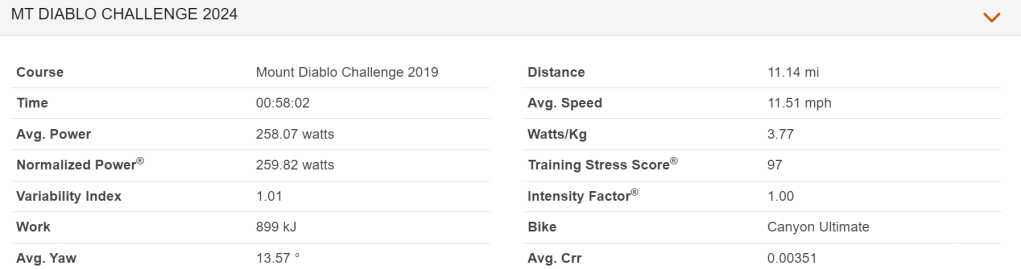
Based on this ride profile from BestBikeSplit, the challenge is whether I can actually sustain my FTP for one hour. This rider plan is asking me for 258w average power to finish in 58 minutes, basically the same as my eFTP.
What I need to train for over the coming weeks:
Do I have the longevity/focus to sustain power for an hour?
Can I generate higher power at a lower cadence (65-80 RPM) for that time period?
Can I lose a few pounds without losing power to improve my odds at reaching my goal?
On the first question, I have been in polarized training, with 8+ hrs of zone 2 indoor riding each week, for the past 6 weeks. I bookend those sessions with two high intensity Zwift racing sessions of 30-45 minutes. This ends up looking like 400 TSS and 5000 calories burned each week. Since school season has started for my kids, I’ll add a 30 minute commuter ride each morning in which I bike them to school with a trailer. I won’t measure this physical impact, it will just be a bonus. What I need now is to practice one extended climb at high intensity each week, Alpe Du Zwift. In the past, this climb would take me between 53-56 minutes depending on my fitness, a perfect simulation for race day.
On the second question, I have noticed that it’s difficult for me to go 260+ watts seated now. I used to do extended climbs from 70-75 cadence easily, but that’s gone. I can’t deliver that power at above 80 cadence either. When I did my FTP test, I had numerous bursts of climbing out of the saddle. Typically, I can’t stay out of the saddle for very long without feeling overly exerted, and yet this time I just wanted to stay out of the saddle. This seems to signal that my fitness is pretty good but that I also need to practice lower cadence riding. Over the last year, I have focused most of my time on aerobic higher cadence (90+) workouts. Over the coming weeks, I want to spend at least a few hours at lower cadence (70-75) each week, not including my climb practices.
On the final question, nutrition has always been tricky for me. Do I take in nutrition during the ride? Or just pre-ride? How much protein do I take? Should I listen to my body and eat when hungry? Over the past years, clear patterns have emerged. If I train, I gain weight. I don’t get leaner, however. My percentage of body fat stays the same or increases. Gaining weight means I eat too much, period. Over the next month, I’m going to execute the following:
Nothing outside of water after dinner (this usually ends by 6PM).
Be a little hungry each night.
Have a good carb loaded breakfast of sugary cereal and a banana each morning when I have a workout planned. Couple that with a 30G protein shake.
Use Gatorade Zero tablets instead of optimized sports drinks with high sugar. This along with my long bouts of Zone 2 will emphasize fat burning.
Stay low-carb (or couple high carbs with high fiber) for my other meals and focus on eating normal portions. Eat 1 pound of broccoli at least 5 times per week. Don’t overly focus on getting “enough” protein.
If I start to feel too hungry at night, make the breakfast sizes larger so they go directly into fueling the workout.
Don’t weigh myself until race day.
On race day morning, and the dinner before race day, I’ll load myself up with good carbs – fruits, high fiber pastas.
Focus on the process – eating leaner, good workouts, more endurance during extended climbing.
This morning, I won my first Zwift race! And to be honest, it wasn’t really close.
After more than 5 years of fluctuating between 3.5 w/kg and 4 w/kg, and never getting close to a B class win on Zwift, I’ll take it. Normally, winning a lower class would be called sandbagging. This is slightly different, I think. I’ve been off Zwift for close to 4 months and have been recently recovering from painful cycling injury.
Sincemy layoff, Zwift released its new Zwift Racing Score and reset its recommendations for riders. Or at least reset them for me. When I got back on Zwift last week, I got recommended E class. So I took it. I didn’t even podium that one. If you compare my performance in the first race to today, I worked harder (higher heart rate) in the first race, but did 13% more power (this is a lot in cycling) this morning – I was still a bit weak and a bit sick then. I didn’t even win the second race I did, in which I got recommended class D. I finished fourth – my indoor trainer went crazy and I had no power data for 15-30 seconds in the last few minutes of the race. I had expected to podium, but not win – I made the wrong call not to follow someone and my group wouldn’t work to catch up to that breakaway rider.
So again, it’s not like I’ve been destroying the competition taking easy wins.
Today though, I was feeling reasonably decent and when a gap opened up even though I wasn’t working at my limits, I decided to keep pushing and try to stay away from everyone else. It worked and the result was a 45 second victory in the field of 18, pushing about 3.6w/kg in Normalized Power (NP) for half an hour.
Zwift isn’t going to let me compete in C again, so at least I got one victory to show I don’t belong in C.
“All Dirt Fondo routes are planned with mountain and gravel bikes in mind. Upright bars and suspension will have advantages on the trails and rutted fire road segments, but a gravel bike is great for the smoother fire road bits and road segments. Either way, be prepared for some challenges along the way and walk tough sections if it looks too difficult – no one will judge you!” 2024 Dirt Fondo in Marin, CA.
Unfortunately, I took a hard fall last Saturday at the Dirt Fondo. I flipped on the bike riding a heavy rock garden-esque descent, landing primarily on my right leg around the knee. If you look at the images in the link, my descent was comparatively much rockier and chopped up – imagine pieces of large rock. I later realized I took some impact on my hands (I assumed I tried to brace myself), right forearm and left leg as well. The shock was immediate. I couldn’t move for a while and my right leg just shook uncontrollably. I had a small 1inch diameter cut below the knee which didn’t look bad but I immediately thought, what if I broke my leg?
I was fortunate that a pair of riders was right behind me and saw the crash. They helped make sure I was ok and went back to the previous rest stop to ask for help before moving on. I waited a bit, but when it didn’t seem like help was coming, I decided to continue downhill to make the next rest stop and get help there. Unfortunately, I never saw another rest stop but I did hear from another rider that I was being searched for and I was able to send an update via a volunteer. I rode through more gravel/dirt/rock sections before taking a detour and finding pavement as I rode through beautiful Sausalito back to the start – another 2 hrs of riding after the fall.
Should I have picked a different path? This is probably the critical issue. Going down, the edge of the mountain was on the left. I am guessing a 10 foot wide path total split into two. On the left edge is a loose (smaller) rock path, on the right is a rock garden-ish path. I don’t remember exactly why I took the right, but here are a few notes I’ve reflected uplon. There was someone going up hill on my left. Did I see that person before picking the right side? I’m not sure but that would have been a reason to go right, there wasn’t room. Loose rock is very slippery, and because that was the mountain edge side, I may not have wanted to be struggling with slowing down on slippery rock. As I started descending perhaps I wanted to move to the loose rock, but that would have been very scary to attempt. I kind of knew the rock descent was difficult but the decision would have been to focus on surviving, not attempting a tricky transition.
Should I have run different (wider) tires? I ran pretty wide tires for gravel, 42mm S-Works Pathfinders that expanded to 47.2mm on my wheels. MTB tires can be 10-20 mm wider but after I fell, I saw other gravel bike riders (who took the other smaller rock line) on thinner tires.
Should I have run lower tire pressure? Anything can be second guessed. I was running 22/23 PSI on my tires, which I feel is pretty low. The pair behind me were running wider MTB tires and suspension bikes. Less air would have meant a softer ride but I don’t think that was the culprit.
Should I have gone slower or faster? On unpaved terrain, I have learned that going faster is often better than going slower because speed helps you roll over obstacles better. I don’t think I was going fast at all, most likely less than 8 mph. It’s hard for me to remember because it was a descent, I was for sure braking or in a brake position in the drops and I was in a rocky path in which I was just trying to go over big rocks non-stop. I didn’t want to go too fast because I didn’t have good traction but going too slow would stop the bike because of the rocks.
What was my position on the bike? Earlier, I mentioned I flipped over the bike. I don’t think that’s accurate. I didn’t land on my head. I think the bike got stopped on a rock and I had to fall over in the process. I don’t think I was front leaning on the bike, but I’m not sure if I was sitting or in a more crouched/standing position on the saddle.
Sitting down, writing this a couple of days later, I of course want to blame the event a bit. If I’m the only one who fell (I do not know if this is the case), then I have to assume it’s my fault, whether that be due to lack of skill, bad luck, or something else.
As for my injury, I learned I haven’t broken anything, or at least nothing that can be seen on X-Ray. That’s good news so far. The bad news is that I couldn’t walk the day after the event because of the swelling in my leg. Thankfully, my body let me ride and drive home on the event day – I was 1.5 hrs driving away from home.
I feel a lot better two days after the accident (if not a bit tired) and remain hopeful I just need time to heal. I can’t walk unsupported yet.
Cycling is an expensive hobby. (If this were a podcast, I’d just stop talking for a minute. FULL STOP.)
However, I am generally able to buy my gear at vast discounts (50% and above), including helmets, shoes, jerseys, bibs. Even groupsets! These are typically new or open box and high-end. Yes, some (clothes specifically) of it may be off-season but that’s totally fine unless you think things change rapidly in 1 to 3 years.
I want the best possible stuff at the best possible prices and I will wait for deals. I am not someone with a special size either – if you’re really small or really big, your sizes tend to sell out last so you have access to more deals. I wear small in jerseys and bibs, have a large size head, and wear 9.5 and medium / large sized gloves. I basically compete with most people on gear.
Here are some purchases from 2024 and how I got them.
In general, I like to research what’s good. Sites like In the Know Cycling help me whitelist certain brands or items to remember. Price, along with brand can be a signal too. Is this the most or second most expensive shoe this well known brand makes? It’s probably pretty good.
As of this writing, you can still get this on Amazon from a third part seller in new condition. In general, Amazon doesn’t have many high end cycling brands. When they do, products are almost always sold by third parties. If you see certain products you like listed, you can use CamelCamelCamel to bookmark and track the price history of an item. You can see if it’s ever been cheap and to notify you at certain price thresholds. I didn’t do that for these shoes. I just searched for them and noticed a good price when I went into the “other sellers on Amazon” box in the product page. I was in searching for pricing on various shoes and noticed this.
I also found these Muc-Off Tubeless Valves V2 for $15.01 that way – they retail for 34.99, 57% off. They were sold as previous returns in like-new condition by Amazon Resale, formerly Warehouse Deals. Mine weren’t even opened.
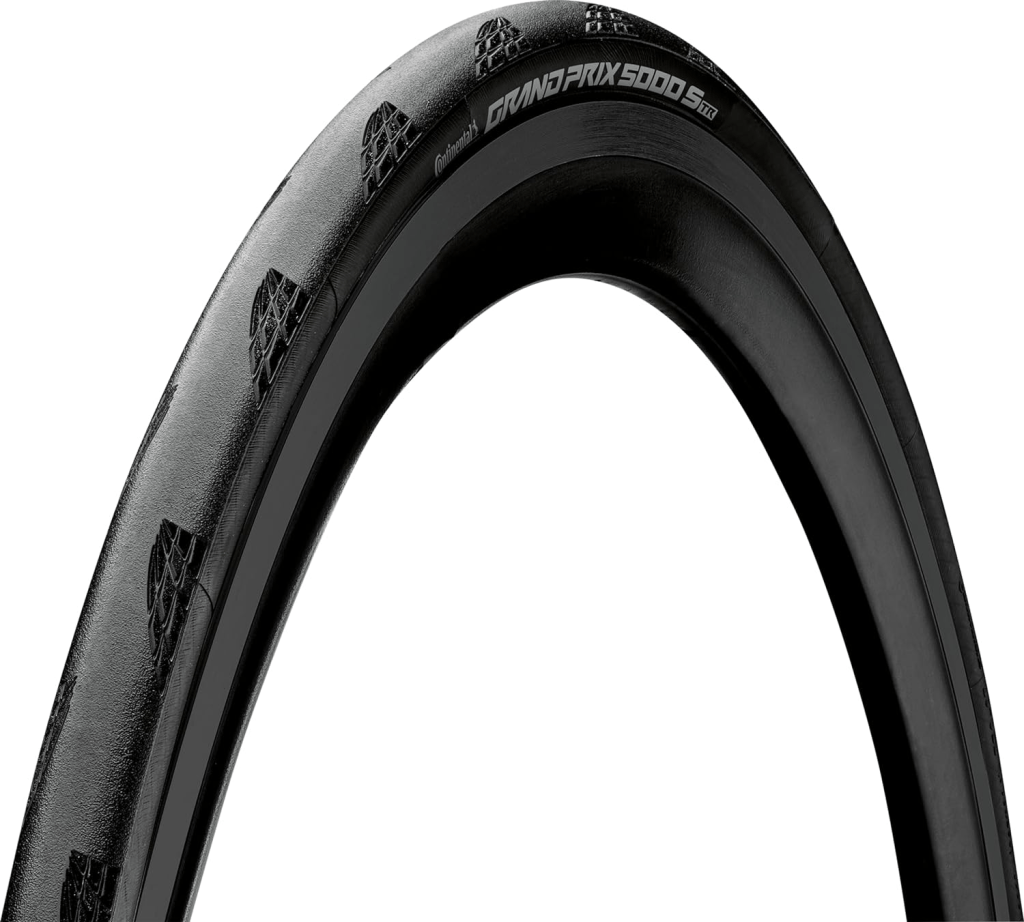
This is the most popular version of these super fast tires – probably the best all around tire in the world right now. These typically sell for over $95 online and are rarely discounted, but I got alerted when a seller was selling them open box for just $45.88.
In recap for Amazon, as you learn about things you might like, random searches on the site from time to time and using CamelCamelCamel for automated price notifications are really useful. For what it’s worth, I don’t think I have ever found high end bibs and jerseys sold on Amazon.
I’ll give a few more examples, but here are some resources that are worth looking at:
The TrainerRoad thread is a great place for sharing and discussing deals.
BikeCloset is the best single store for deals. It’s the only store I’ll actually subscribe to for notifications. I have bought high end jerseys and bibs there from Castelli, Assos, Louis Garneau and other brands at 50% or more off for things retailing at $150 or more. For the discounts, you have to deal with them not having images for so many things and showing so many out of stock items. There are rarely any descriptions. They’re kind of saying here it is, go do the work online to see if this is the thing you want and the price you want to pay. But that actually appeals to me.
I have never purchased bibs or jerseys for over $100, which is the entry-level clothing price for most of these high end brands. Typically I am getting the first or second tier (Assos is really expensive) product tier at less than their entry level price.
BikeTiresDirect is solid, but its deal volume is nowhere close to BikeCloset – BikeTiresDirect is like a regular store that offers great pricing from time to time, while BikeCloset is a full on clearance outlet, like a Nordstrom Rack for high end bike gear. While there are plenty of sites that offer sales, I prefer to check them out on my own from time to time or see if someone mentions something on TrainerRoad rather than getting email blasts.
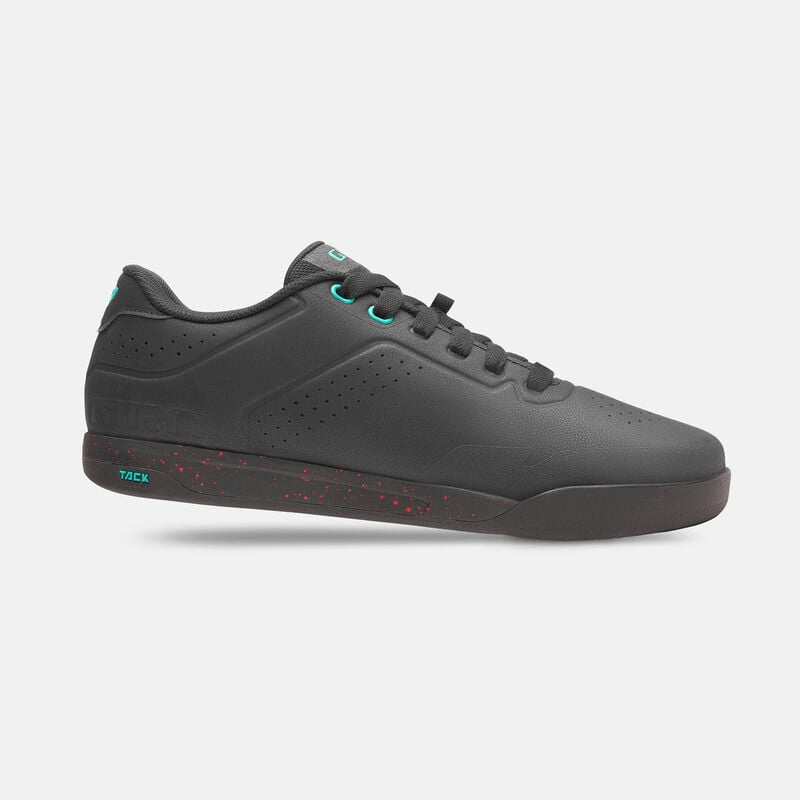
I bought these Giro Latch shoes, a flat pedal gravel shoe, for $63.38. (Retail: $149.98, 58% off)
GearLab loved this shoe as a super sticky but lightweight alternative to the Five Ten Freerider Pro, so I looked for deals. I found one through Google Shopping and it’s an example of finding deals by being flexible on style and colors. That’s not to say I’ll just dismiss style completely, but it’s not common for me to find the right product in my preferred color.
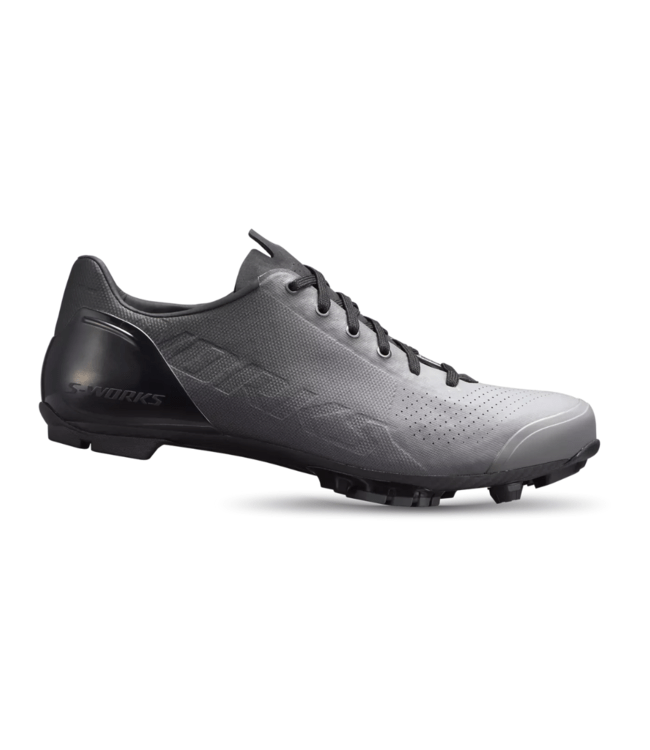
The exact same thing happened with getting this S-Works Recon Lace for $112.99 (Retail: $324.99, 65% off). Anything S-Works is the creme de la creme in Specialized’s product line.
Same story with the Giro Aries Spherical Helmet. Purchased for $148.51 as an open box item. (Retail: $299.95, 50% off)
This is the #1 helmet rated for safety by Virginia Tech and Giro’s highest end helmet. White isn’t my favorite color, but it’s also the coolest temperature color and make sense for a helmet focused on cooling.
To sum up, it’s really not that complicated. Research, tools, flexibility on brand and color/style can get you a long way with using the very best products at entry level pricing. If you’re curious about eBay, I think eBay is really good for niche items (that are rarely listed) in excellent to like new condition that are then auctioned. You can find special deals then because most people aren’t looking for those items. Things can slip through the cracks so to speak. I will save notifications on keywords for items that I am interested and simply wait.
If you have any tips, I’d love to hear them. Good luck!
This all started with a desire to ride off-road a few years ago. When COVID came, quickly followed by a move to Colorado, I was primed to be another road cyclist converting to safer adventures away from four wheel vehicles.
I bought an entry level hardtail mountain bike, ventured out once into 15 degrees F and snow, but never had much of an opportunity to explore further in Colorado as I soon moved back to California, and found myself a 30 mile drive from actual mountains.
I then became obsessed with the idea to build out a top of the line gravel bike at a non-top-of-the-line price. And so started this appeal to my loves of research and deal hunting.
The total cost of the build, was $5,126 or the equivalent of $4,736 before local taxes.
I built a 2024 Giant Revolt Advanced Pro weighing 17.9 pounds (8.1 kg) with pedals (or 17.1 pounds without (7.8 kg) if you want to compare it to the standard way bicycle companies and retailers list bikes). 1×13 speed with Campagnolo Ekar, a Cane Creek suspension stem paired with a Ritchey WCS Venturemax carbon handlebar, and a Light Bicycle XC930 wheelset that weighs just 1142G with tubeless tape rolling S-Works Pathfinder 42mm tires that have widened to 46mm.
While $5K is a lot of money for a bike, this is not quite on the upper end as bikes go. Keep in mind that Giant’s own top of the line build, the Advanced Pro 0 is $1,500 more at $6,500. Other than lacking electronic shifting, I think my build is better.
If we’re going against this nine bikeGravel Race Bike throwdown, this build would be the second or third lightest bike and the second cheapest. To be fair, my build would also be the only mechanical shifting bike.
If we’re talking about adventure bikes, my build would be the lightest and 4th cheapest of the nineteen in contention.
I realize that price to weight for a bike says very little about if the bike is actually good, so let’s go further into the specific components.
I don’t race, but I still want a fast bike, a bike that would be good enough to be great in a race even if its rider was not.
The Revolt isn’t aero, but it’s received wonderful reviews, including Bike of the Year from Bike Radar in 2022 and Ben Delaney’s mention as his favorite gravel bike of 2023. Delaney’s thoughts mean a lot to me because unlike most people, he’s basically tried all the bikes and been successful racing many of them.
The Revolt has a much more relaxed geometry relative to dedicated gravel race bikes like the Cervelo Aspero 5, making it comfortable as a general adventure bike and perhaps road endurance bike. You can optimize performance for smaller (up to 45mm) or larger (up to 53mm) tires with its flip chip. It has a ton of mounting options for bikepacking and the top tube bag as pictured in my build.
Overall, I felt the Revolt could somehow be and do everything for both racing and general adventure and yet this premium frameset only retails for $2100! The best offerings from Specialized, 3T, and Cervelo cost from $3,500 to $5,000.
I have a gravel event in April, so I’ll be using 42mm (46mm actual width) S-Works Pathfinder tires for that. I’ll then try a double century (200 mile event) in May with 35mm Continental GP5000 AS TR road tires as I use the Revolt as a road endurance bike. Expect for me to give ride impressions from both styles of riding in the future. Even though I could easily run the bike slammed for looks and slightly more aero performance, I’m trying for a more relaxed approach first to see it how feels.
I bought the frameset from Clubhaus in New York, which shipped it to me for free with no sales tax. I really liked working with Effy – he answered all my super annoying questions and even got on calls with me. He didn’t ignore me post-purchase either.
Late last summer, I bought my second pair of wheels from Light Bicycle, a 37mm external width ultra wide, 1150g ultra light, non-aero tubeless hookless wheel set.
Light Bicycle also sells a gravel-focused wheelset with 30mm external width. Here’s how those two options stack up:
From watching recent trends in road cycling, I felt it didn’t make sense to put 40mm+ tires on 30mm external width rims. I thought a even wider rim would make the actual tire-on-rim width wider, providing more traction in the dirt without adding extra weight, facilitating lower tire pressure, and avoiding the lightbulb effect with tires that are significantly wider than the rim they’re on. Since I’m completely new to gravel, I was worried my thought process was dumb but I asked around to get enough confidence I wasn’t stupid and that the XC rim (normally for heavy duty mountain biking) would hold up great for gravel. Conventional wisdom and bike industry standards say it’s not a good idea, but since I started riding in 2016, common tire sizes on the road have ballooned from 23MM all the way to 28/30mm. These last 7 years have seen a huge shift relative to the decades before them and I would not be surprised for gravel wheelsets and tires to make the same jumps soon.
I know that aero gravel is becoming a big thing, but I’m just not sold that 40MM+ width tires on 40mm depth wheelsets are actually all that aero. (See Rene Herse and Hambini) I agree that deeper wheels look nicer, but I think the wider tire sizes being run by most people negate most of the aero effects. Now, if you’re a high level racer cranking up massive watts to overcome the slower speeds of dirt riding, there’s probably some positive net effect there, but I’d rather have my ultralight wheel set – deeper gravel wheel sets are typically 1500G or more, nearly a .8 pound gain on my XC930s. On the road, I can average 20MPH riding solo for a couple of hours on relatively flat California valley roads, but I doubt I could get above 18MPH on dirt with the same depth (46.5 mm) aero wheels.
These XC930 wheels cost me just under $1300 and are laser etched to celebrate the birth of my daughter. Ignoring that level of customization, which isn’t available from most wheel brands, these wheels are easily, at least in spec, the match of $2K wheels from more known Western brands.
I consider Campagnolo a brand for the super wealthy bike enthusiast. I never thought I would ride a Campagnolo groupset.
The groupset retails for $1700, but last year I saw that new sets were selling for under $900 on eBay. Even though Ekar was mechanical shifting, I liked that it was 13 speed (Shimano and SRAM were 11 and 12 speed), it was the lightest gravel groupset around, and it may have the best braking performance among gravel groupsets.
Ekar also looks great.
While I love electronic shifting, an alternative from Shimano or SRAM would not have been available at the Ekar price and I would also miss the benefits stated above. I saw this as a chance to get the best of mechanical groupset technology at a great price. An un-Campagnolo-like price.
I have no bike handling skills that I am aware of, and I was worried about fatigue from riding in the rough. Carbon components help with compliance, but when I read people’s impressions around suspension stems from Cane Creek and Redshift, I wanted one for my build. The impression was that it was a real game changer as a shock absorber for one’s hands.
At the same time, I wanted to keep the original specs of the Revolt handlebar/stem system that had won the bike so many accolades, and those bikes came with a 60mm stem for size small frames. Neither Cane Creek or Redshift had such a short stem, but when Black Friday came around, both had nice discounts, and Cane Creek has the smaller stem option at 70mm.
It’s about 140G heavier (.3 lbs) than ultralight options, but I felt the performance benefit was worth the weight.
The decision around the Venturemax handlebar came from wanting something light weight with flared drops (wider in the bottom than the top) for improved handling in the drops and a flat aero section for hand position on climbs and normal riding. I also liked the more aero position of having hoods turned inwards.
• Drop 102mm (-23mm)
• Reach 76mm (+4mm, or +14MM if including added stem length)
• 24° Flare (for 52.5cm width at the drops)
If you look through the rest of my build, you’ll notice titanium screws and a number of other decisions for aesthetics.
Overall, the frame’s Forest Green color is complimented with red/pink and gold through the build. The wheel’s spoke nipples mix florescent green and red to reflect my daughter’s nickname, Strawberry.
A few more items I want to note: • The S-Works Pathfinder Pro tires are super fast, super durable with good traction and one of Ben Delaney’s favorites. They expanded from their 42MM official width to 46MM on my wheels. They’re low weight for their width and I can run them at low pressure and feel comfortable on a wide variety of rough terrain. I didn’t want to have 4 different types of tires that I’d need to switch out constantly. These tires are also a good deal at $70 relative to high end road tires that are typically $100 each. • Since this bike was for gravel riding, I was worried about paint damage and looked into paint protection options. Invisiframe looked like the best deal for complete frame coverage. The work to get it installed is very hard and time consuming. In fact, even though I worked on it for hours (do it in sunlight so you can see imperfections easier), I still left some problems. Invisiframe was awesome, however. When I asked if they had a few extra pieces they ended up sending me a whole new set because I messed up half the install. It wouldn’t be so obvious to someone a couple feet away, but it was obvious to me because I had worked so hard on it. Unfortunately, I didn’t get the second set perfectly done either, but it was better than the first time. When I moved the frame into outdoor sunlight through my garage, I tapped the frame’s rear wheel area into a wall or door and some of the paint chipped off. Yes, I chipped the paint in the process of trying to get the paint protected. Idiot. • I got the Apidura top tube bag because it is much easier to access when riding compared to handlebar bags and thus better for eating while riding. This bag can screw into the Revolt frame instead of using straps, it’s thin to avoid touching my knees, and people regard it very positively.
Notes around Building up the Frame
Putting this bike together was more than just the research, I wanted to build it all myself as well. With all the parts I gathered, I was aiming for a light, fast, and very comfortable bike that could go on a wide variety of surfaces and ride fast on all of them.
I was able to figure out most stuff on my own, but did end up getting some help to cut the seatpost and steerer tube as well as to fix the shifting. While I can’t say I ultimately did it all myself, I feel I learned enough to which if I did it again, I could do it all myself.
A few more notes:
1) The Giant Revolt Advanced Pro frame was a bit heavier than I expected. I was hoping to achieve a 17 pound build, but missed that by a pound.
2) The steerer tube spacers only look good with Giant’s handlebar, which doesn’t come with the frameset. Using them with a normal stem opens gaps for dirt to go through, which I wasn’t comfortable with. It was not so easy to find options for alternative dust caps.
3) You can’t fully hide your cables because the Revolt has a standard size head tube. I had asked Effy from Clubhaus about this before purchasing, but was a still bit disappointed.
The real difficulty around the build was Ekar. I learned that setting it up could be a real pain, specifically around the getting the shifting right. I eventually took it to my local bike shop and even they had issues. It got to the extent I did not know if we could solve it because few people have experience working with Campagnolo or Ekar, and certainly no one in my area. In the end, I don’t know exactly what the fix was but I ended up compiling a guide to help future Ekar enthusiasts.
Thanks so much to multiple communities, and primarily the folks at Paceline, for talking through things with me.
Future Changes
I’m really happy with the build, and I’m not sure what I want to do for more weight/performance optimizations. Of course, I need to start riding it extensively first!
If I can get a 165mm Ekar crankarms for cheap, I’d like to do that as I ride 160mm on the road.
I could also get a lighter seatpost that’s still gravel/compliance oriented and a lighter version of my current saddle, but that’s probably about 160g (.35 pounds) of potential weight savings at $400 or more. Perhaps it’s inevitable I’ll make those changes but thinking about it now, I’m not so sure I care.