I have a fairly extensive collection of sports jerseys from various sports, thought I rarely actually wear them. Of all sports, I think the soccer jersey is the best for wearing in normal every day life, especially as jerseys in other sports tend to be oversized for the average American male. Player-level (what they wear) jerseys tend to go as small as 40 (men’s medium), and I’d normally wear a 36 (small).
That said, I do like to wears jerseys to support my fandom, either going to a game (rare now) or watching key games from the team on TV. Unfortunately, I’ve convinced myself that my jersey wearing is strongly correlated (if not causal!) to my team losing.
I don’t remember a win while watching a game on TV with a jersey. Some of the brutal losses:
Warriors lose to Cavs in 2017 Finals, Game 7
49ers lose to Chiefs in 2020 Super Bowl
49ers lose to Ravens, this past Thanksgiving, the only time I wore a jersey this year.
I am sure there are a few more, because this guilt has been building over time. Am I typically superstitious? No. But last night went too far.
I wore my Patrick Willis jersey watching the 49’ers fall behind 24-7. I decided to take off the jersey, just in case.
The 49ers went on to overcome the largest half-time deficit in NFL conference championship history. It didn’t even take the full game, it took 12 minutes, less than a quarter. to overcome the curse.
This year, our family committed to doing more in the snow. Lake Tahoe is about 2 hours away, and we wanted our kids to take advantage of winter activities that neither my wife or I were in a position to do from our youth until really, now.
I wanted my oldest son (5 years old) to start snowboarding so that I could learn as well, but little did I know what I was actually getting into. – I thought cycling was expensive, but it turns out most of the outdoors is expensive. Here’s a breakdown of the equipment we had to buy:
Keep in mind I spent over $2k for myself and him, even after over 30% in combined off-season discounts. This also doesn’t include the family pass ($450 for a season, considered to be a bargain) and one time private lessons at $200.
A couple of weeks ago, I raced the Mt. Diablo Challenge for the first time. I finished:
I finished in the top 27% overall and top 23% in my age group doing 233 watts, about 3.45 w/kg. However, I don’t have any doubt I can finish in one hour with possibly a top ten finish. Before I talk about why, here are my impressions of the event:
Mt. Diablo is a well known San Francisco Bay Area Climb. But most of my riding has been in the South Bay (Mountain View to Morgan Hill) and Sacramento. It was my first time riding this famed climb.
Driving into the parking lot at 7:30AM reminded me of when car enthusiasts get together to show off their cars. Even though I’ve been to plenty of mass rider events, I felt such a strong concentration of “Wow, that’s a $10K bike! There’s another…and another”
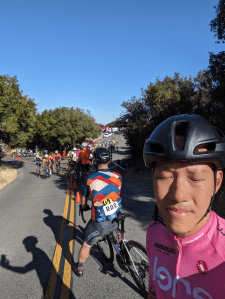
The view going up and down was great. I really enjoyed the descent, riding with a hundred other people down the road, just awesome views and a happy feeling traveling with so many people. I don’t do a lot of social riding, and even then I’m not a talker, but just being with so many people not needing to talk fulfilled my togetherness quota for the year. As you near the finish line, those who finished before you are waiting to urge you in the final (super steep) section. That’s me below watching (yes, eyes are closed) the people climb up.
Now here’s why I am confident about achieving the 1 hour mark (you get a special shirt for it too!) next year:
I participated in the Sacramento Century (100 miles but less than 1000 feet climbing) the day before. While my IF (intensity factor) was a relatively conservative .64, this turned out to be my highest all time power for the 5hr 10 minute ride. My back was hurting during the ride and my legs were a bit worn even after the night’s sleep. Clearly, I didn’t come in fresh. I thought I’d warm up and feel good after starting the ride, especially with a boost from caffeine, but I felt the effects of the previous day throughout and I started losing a lot of power in the second half of the climb.
Why was I silly enough to schedule two events like this back to back? I actually didn’t know they were back to back until about a month prior – I had already been signed up for a few months at that point. I would have preferred to do Mt. Diablo first, but that wasn’t up to me. I decided to keep the century ride because I thought my pace would be casual enough so I’d be ok for the race. I knew there was a risk but I just wanted to keep both events since I’d never done either before.
The week before the race I had done 269 watts over 28 minutes on a simulated Zwift climb. People like to say FPT power is the theoretical max 1 hour power someone can produce. If you don’t want to do a hour hour test, they’ll take 95% of a 20 minute test. Using that 28 minute power, my FTP should have been at least 255 watts. My guess is that I am closer to 260 watts. This is BestBikeSplit’s guess for what I could do at that rate. Looking at this year’s results, top ten finishers are right below the one hour mark.
My own tips for next year’s race:
I’m not doing 100 miles the day before the event. Complete rest at least 4 days before the event, focusing on good sleep.
I didn’t understand the bathroom situation so I waited in a long line where I picked up my packet. A few miles away at the race start, there are plenty of bathrooms. No more stress next time.
I’m taking off all my bottle cages and not bringing water. I brought one water bottle this time, but I didn’t need it, and it’s really hard to go all out and drink without losing momentum. I’ll drink during the drive over and then pee at the race start. That’s a saving of at least 1.5 pounds, almost 10% of my bike’s weight.
I’m not sure how far I want to go weight weenie, but I could also go with thinner tires. I went with 25mm/32mm front/rear since that’s just my normal setup, but I could see myself going 25mm/25mm just for the mental benefit. I’m curious about this cassette to save another .2 pounds, but I think that’s overkill and I’m worried about its reliability.
I am highly dependent on my Halo headband to absorb sweat and like an idiot, I forgot mine in the car. I was already miles away going to the race start when I realized this. Since the morning was cool (around 55F), I didn’t get affected by sweat too much, but it was definitely a mental stress and I did have to handle it a few times. Again, when you’re going full out for an hour, every little distraction can kill momentum.
I didn’t use sunglasses to avoid sweat and visibility issues (and a little weight) and that was the right decision. I was good with my clothing choice, and didn’t use gloves.
I had two caffeine bars (around 160mg total) but I think one would have been fine as I don’t consume caffeine often. I’ll test this a bit over the next year.
Training – I’ll work on 1 hr climbing over the next year and if I’m consistent I think I could gain up to 10 more watts (4% increase) and lose 2kg. The power gain is fairly modest.
I’ve now used them for about 1K miles, including 12+ hours on the Davis Double Century. Photos from that event during different times of day below. My rides this spring with them have span from 50F to 90F. My takeaways:
TLDR: I’d buy them again.
They’ve been great. While the Davis Double Century ride was cooler (85F) than in most years, I still felt very hot in spurts during the climbs (close to 9K feet total). I didn’t feel distracted by the glasses despite reduced air flow. This might change as the weather gets warmer and I do more stressful (peak power) climbs. My helmet doesn’t have a good spot for holding the glasses, otherwise I’d take off my glasses during hot climbs.
I thought that the outer lenses picked up a lot of scratches but I learned these all came off with lens cleaner. I just applied some and the lenses look brand new again. I’m still using the original wraparound outer lens but the glasses come with multiple replacements of various tints. The glasses do pick up fingerprints / blemishes like crazy – I don’t know how expected this is for Oakleys or other premium cycling glasses.
Prescription vision has been great, no headaches or other issues. Again, these were $50 per pair (I bought two).
The only area of improvement I’d like is a stopper against the forehead – you can essentially put these glasses into your eyes – this sounds worse than the reality. The glasses don’t really move during riding, sometimes I’ll push them slightly up so they’re covering more of the vertical vision area.
Occasionally I hear Jim Barnett and Bob Fitzgerald, the Warriors’ TV announcers, talk about how players who stay in college for additional years do not lose much from doing so – that not only do such players get better and become more mature from the experience, they also end up making the same amount of money (or perhaps more) from elongated careers.
As a Cal Bear, this makes me think of the upcoming decisions of super freshman Ivan Rabb and Jaylen Brown. Sorry Jim and Bob, I disagree with you because of former Warrior Chris Porter.
Porter is expected to be a late lottery pick in the June NBA draft. He could have been a lottery pick had he come out after an All-American junior season last year.
Chris Porter lost potential lifetime financial security by staying in school
Over 15 years ago, Chris Porter was a hot NBA prospect, projected to be a lottery pick after his junior year. He was featured on the cover of Sports Illustrated. A year later, after giving scouts a full year to focus on his weaknesses, he was drafted by the Warriors at the 55th overall pick (I was very excited by this pick, as I remember).
Let’s break this down for Rabb and Brown. As of today, according to DraftExpress (a reputable source on pre-NBA talent), Jaylen Brown would be the 4th pick (or is the 4th best prospect, however you want to read it) in this summer’s draft. Ivan Rabb is 14th. Both would be considered “lottery picks”, draft picks for teams that do not make the NBA playoffs, just as Chris Porter could have been so long ago.
So why should both Rabb and Brown leave for the NBA?
In a worst case scenario, any 1st round draft pick gets two years of guaranteed money upon signing. As of this year, the amount for the lowest 1st round draft pick (30th) is approximately $1.9 million dollars. Even if a rookie has a terrible agent (see: Ricky Williams / Master P), he would still more than likely get at least $1.5 million. (I am going to leave any net present value arguments out of this entire discussion, as well as taxes, agent fees, etc.)
If their draft positions hold, Rabb and Brown would get closer to $3M and $7M, respectively.
Minimum $1.5M dollars and a (virtually) guaranteed spot at worst case on a NBA basketball team for two years is nothing to scoff at, especially if you did not grow up in a fairly affluent family. I went to Business School at Kellogg (Northwestern). If I were offered this deal today, I would absolutely take the $1.5M now, despite having a good amount of work experience and knowing I can do other things. Thus to paint 20 year olds (who are probably unable able to do other things at this state in their lives) as silly for taking the money is a bit ridiculous.
Yes, it sounds great to believe in your talent, that the money will always be there, but that’s actually the dumb move.
Taking money now is the smart thing, if it is guaranteed. For any player’s long term development, he has to be in a good team situation in which he can grow (compare San Antonio Spurs vs Brooklyn Nets) – this is something a player has much less control over and thus, has much more risk. The money is guaranteed while the opportunity to play, be liked by a coaching staff, is not.
What are the opportunity costs for staying?
Other than having your draft position go down, costing you literally millions of dollars, if you get booted to the second round as Chris Porter, you will not have a guaranteed contract, or a contract at all. Let’s ignore the chance for life-changing injury too, which could happen but is rare.
In other words, if your stock falls for whatever reason and you fall out of the 1st round, you will AT BEST be making just 3.3% of what you would have made, IN THE WORST CASE, as the lowest chosen first round draft pick.
This is a huge drop. Yes, someone could make good money (six figures to low seven figures) internationally, but if you are just starting your career and feel you are an NBA player, you will probably try the DLeague first.
A key thing to note here is not just the relative different of the 96.7% drop in salary, it’s the absolute drop. If you had this disparity with Kobe Bryant’s pay, you would still be making $750K per year, a ton of money for 99% of Americans. But this is $25K, and you won’t be flying first class, staying in nice hotels. This is bus life, a hard way to earn $25K (roughly equivalent to making $13/hr at a full time job for a year).
If a player stayed in school in order to complete his college degree and then dropped out of the first round, I would say he wasted the point of going to college. Jaylen Brown, Ivan Rabb, get in the draft now and go to summer school in the future.
If you want a more current example of how delaying can matter, look at Skal Labissiere from Kentucky. If he could have entered the draft a year ago, he might have gone #1 overall. After a poor freshman season, however, he might now be picked towards the end of the lottery, a $4.5 difference in guaranteed money.
Is there another way?
In my opinion, college basketball (the talent level) suffers from elite players leaving early. It is harder for non-traditional powerhouse teams to create momentum off of strong seasons (if Rabb and Brown leave, the Bears program is very weak for next year). Players are unable to mature in a more natural (college) setting and have to develop their games in the constant pressure of the professional ranks among men 5-15 years older. In addition, unless they play for a terrible team, elite players will likely see more reps and minutes playing for a college team.This lack of elite players over consecutive years is also part of the college game’s ratings decline.
Solution: Let players enter the draft but continue to play in college.
How this would work:
College Players can enter the draft anytime in their college career.
If drafted in the 1st round, a player could stay in school up to their 4th year after their high school graduation year (you cannot stay in school forever).
Contracts are guaranteed (as they are today) for 1st rounders, while contracts for 2nd rounders can be offered guaranteed (optional by the team, as today). Contracts take effect once the player decides to leave school.
1st round picks do not have to sign their contracts, but their rights would stay with the drafting team until the end of their 4th year after high school graduation. Rights to 2nd round picks would only stay with the drafting team until the next year’s draft (a bit like the college baseball draft).
Players who want to maintain college eligibility cannot leave school and take time off to prepare for the draft process. Instead, teams can visit with them during specific break (spring break, summer break) periods. This will limit the number of workouts (and injuries) possible, but interviews should be fine. Schools like Kentucky would likely hold on-campus “Pro Days” as in the NFL, which admittedly could favor powerhouse schools in college recruiting.
Players give up their college eligibility completely by leaving school and going through the normal pre-draft preparations – this would be no different from today.
Teams can cut players with no salary cap hit (the year the player enters the NBA) in case a player seriously regresses (or for whatever reason), but the player still gets fully paid.
For NBA Teams
Teams no longer have to pay to develop players (ex. Jermaine O’Neal) and then see them leave once they are physically and mentally ready to contribute to a team. Thus, teams pay more for actual expected contribution than potential.
Insurance can cover players who (perhaps this can be paid in half by the player, through his contract, and the team) have a career-ending injury during college after being drafted.
Per Net Present Value, it is always better to have a financial obligation later than sooner.
Non-ready players take fewer jobs away from NBA veterans.
For College Teams and the NCAA
Teams can hold on to players longer, and coaches would no longer be in this weird “I want you to stay, but I swear it’s for your own good, not for mine” position.
Having players for multiple years helps sustain programs.
Consistency and multi-year player resonance creates better television ratings and attention, i.e. business revenue.
For Players
Significantly less risk. If you have a good potential draft position, get drafted and get guaranteed money when you leave. If you’re hot, strike. If you’re not, keep working.
Make progress on a degree (what college is for), become more mature, and improve your skills so you don’t flunk out (see: Anthony Bennett) once you do reach the NBA.
Some other notes about why this makes sense. First, we can look internationally. Teams like the Spurs have signed professional international players for years, knowing they are unlikely to come to the NBA right away. In that time, these players develop further and come to the NBA ready to contribute. These aren’t necessarily older players either – many European players (Tony Parker, Ricky Rubio, Kristaps Porzingis) turn professional as teenagers, before their college-age years.
In addition, with the NCAA’s supposed focus on amateurism, under this plan, players will not get paid anything until they leave for school. This is like getting a job offer when you are still in college, which is pretty common. MBA students often finalize their jobs up 10 months in advance of the actual start date.
I think these changes will not prevent players who can play in the NBA right away (ex. Karl-Anthony Towns) from jumping, nor should it. However, it can help the many players who have the talent, but not quite the skill set, with Brown and Rabb as examples. Jaylen Brown cannot shoot or handle the ball particularly well, and yet his physical talent makes him a great NBA prospect. An additional year or two would allow him to become a great player and make more progress on his academic ambitions without financial risk (aside from if his family needed money to survive right now).
This is a solution that helps everyone – both NBA and NCAA teams, younger players in college, older players in the NBA, and the NCAA as a business. Fans get to watch their NBA teams’ young talent in college and become more devoted and hopeful for their futures while enjoying their favorite college players for multiple years.





 I Spit Hot Fire