
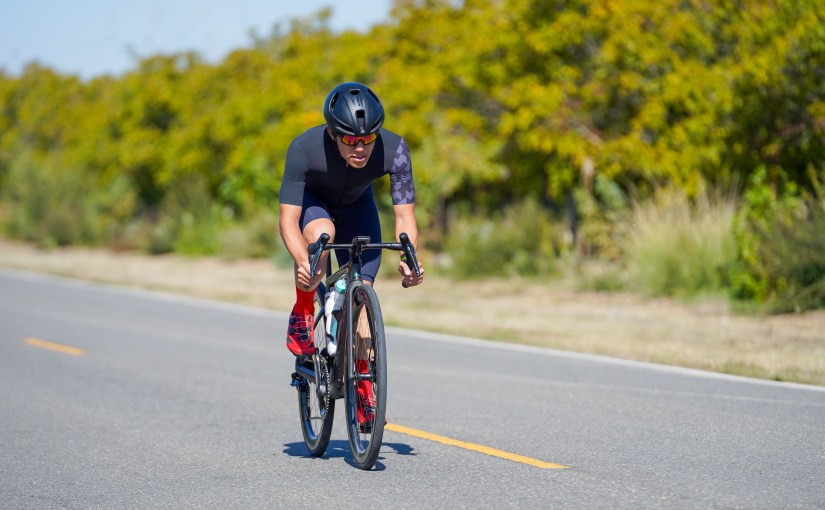
That’s my 2024 Canyon Aeroad CFR is size 2XS.

And this is me last week, at the 2025 Foxy Fall Century, a 100 mile “century” ride event in Northern California.


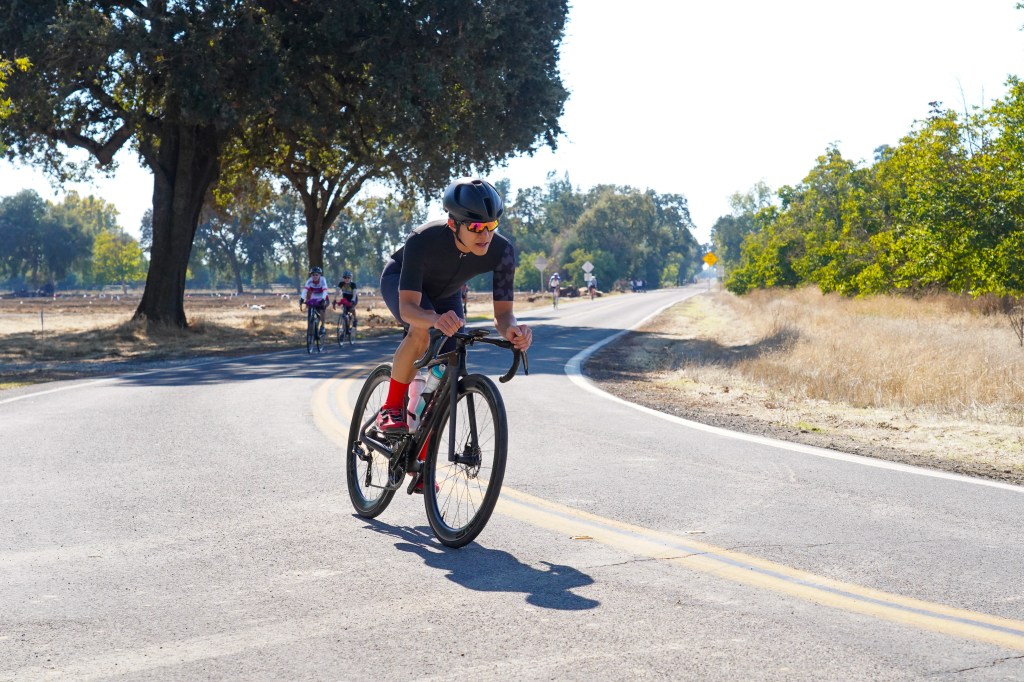
I’ve owned my Aeroad since the end of 2024 but I don’t ride outdoors that often. In fact this 1000 mile review is a lie – Strava says I’ve only done 865.7 miles. I guess this review can only get worse from here.
Still, I am confident in the following statement: The Aeroad CFR is a good looking (to me) bicycle that feels comfortable / compliant (enough), stiff (enough), fast (enough), and fun (enough).
Big emphatic words, I know. Let’s provide more context into me and to why I have these conclusions.
I am 5’6. My FPT has generally fluctuated between 250w-265w, and my weight 145-150 pounds over the last five years. This is basically 3.8 to 4.0 w/kg. Max sprint is around 900w. I don’t race, but I like to ride fast by myself, more as a steady power rider. My Zwift racing score is around 650.
My absolute power numbers are around 50% of all riders my age, while my w/kg (power relative to weight) will be around the 90 percentile across different durations:

This is all to say, I am strong for my size but an average strength rider overall as a small human. That is why I feel like my real world impressions would match more riders than not.
My first serious road bike was a 2010 Kestrel Talon (rim brake), purchased in 2016. This was a carbon frame aero focused bike. A couple of years later, I bought a 2018 Canyon Ultimate CF SLX disc brake bike, a do-it-all / climbing bike. I’ve used aluminum wheels, then 50mm depth carbon v-shaped rim profile wheels on the Talon, then Roval CLX 32 (32mm depth) and Light Bicycle AR465 (46.5mm depth) wheels on the Ultimate. I now run Enve SES 4.5 wheels (50mm/56mm depths) on the Aeroad. The CFR model is their top-of-the-line race bike, with my setup weighing in around 7.2kg (16 pounds) with pedals, a relatively light aero bike setup and the same weight as the Ultimate.
After nearly 10 years of training, and trying various bikes and equipment, I don’t see that much of a difference in everything. When I switched from the Talon to the Ultimate and then back, I did feel the Talon was a bit vague in the power response. But, was that due to the frame, the wheels/tires (I used to run Gatorskins on the Talon), the aluminum (Ultimate had a one piece carbon handlebar/stem) handlebar, or something else? Or my imagination? I don’t really know.
I’ve gone from solid entry level to the highest end of frames, groupsets, and wheels. I’ve gotten stronger in my personal fitness.
I went a few months between riding the Ultimate and Aeroad, and I didn’t feel anything significantly different other than the bike fit. On the Ultimate, I was a size XS, and on the Aeroad I ride a smaller 2XS.
They both felt like good bikes. They feel comfortable on wider tires (I run 53 PSI on 28/30mm tires), I never feel weird in terms of too much stiffness, or “noodleyness”. I can ride them how I want, and they perform great. As my friend Marc told me years ago when I had the Ultimate, all modern bikes are great.
And I’m inclined to agree. I suspect that you want to find a lowest cost bike with electronic shifting, fits you well, looks great. After that you just ride – while I am sure there are subtle differences between bikes, I suspect that the chatter from people who confidently spout how X bike is so much better or worse than another bike in Y attribute is overblown.
Unless I’m going to do apples to apples comparisons (change the frames, keep all other equipment the same), I don’t see how I can confidently say this feels a certain way because of this specific part. Bikes are systems of components, and you’re part of that system. Most hardcore cyclists are always changing one part or another, so it’s hard to really know what goes into what.
Chris from the Nero Show made a sharp point recently: reviews of race bikes by non-racers are inherently limited, because those riders aren’t using the bikes as intended. That’s fair — I’m not a racer, so what could I really say about its performance at race pace?
But here’s the irony: most cyclists aren’t racers, yet almost every high-end bike is a race bike. If that weren’t true, brands wouldn’t emphasize UCI compliance on frames that will never see a start line.
I actually learned something about the negatives of bike stiffness, in the latest Silca podcast, at 42:50.
Because especially on these modern, you know, very stiff bikes, and he says an aero bike, so, you know, I mean, a lot of those are, you know, they’re pretty stiff these days. You think when you’re climbing out of the saddle and rocking the bike, Your front wheel is able to go with the loads, right? And so you don’t have a ton of lateral scrubbing, but you can hear, like that sound you hear when you’re out of the saddle, that is rear tire scrub. I think we’ve talked about on the channel before, you know, I like to call it skating. Like so many of the modern bikes have gotten so stiff that they’re actually less efficient climbing because you’re putting so much energy into like lateral scrub in that tire. Whereas a lot of the older bikes had sort of a, we call it a modal flex. They had flex in a mode or a direction that allowed the rear tire to sort of almost steer, you know, the forces of the pedal stroke help kind of steer the tire in the direction that the forces are pushing it. And so that reduces the lateral scrubbing in the tire. And I call it skating if you think of like a cross-country skate skiing, right? So not the parallel type of skis, but you see them skate skiing and how like when you angle the ski out and then you put that force and that weight onto it, that lateral movement can translate into forward movement, right? With some efficiency.
You know, bikes that are less stiff seem to have this natural ability and can climb a little bit more efficiently, but you’re also going to wear your tires out a lot less when you’re out of the saddle climbing because you have so much less of that scrub. And that’s something you can hear. You know, we’ve done a lot of testing around this and a lot of work with teams, companies, athletes. But it is kind of cool. Some of these old, like, you know, you guys know how much I love old bikes from the 70s and 80s. I mean, a lot of those bikes, like, you kind of don’t hear any tire noise when you’re out of the saddle climbing on them because they’re flexy. And then you get on some of these modern bikes and you’re like, whew, that’s, you know, that whoosh whoosh sound that’s coming up through your modern carbon wheels. You know, that is the sound of rubber being harmed.
I love hearing that sound when people climb out of the saddle. I feel like I never hear it when I’m riding, so I get jealous of others, but it turns out that this is the sound of damage to the tire!
So I’ve spent all this time basically saying the Aeroad is a good bike, as much or as at least, I suspect, as other bikes. But is it a fast bike?
At the Foxy Fall Century, I ended up doing 100 miles in 5:43, a bit above 17.5 miles per hour. 3,500 feet climbing. Roughly 12 minutes in stoppage time for bathroom breaks, water, stop signs. Speed without that was a bit over 18.3 mph.
Average power of 164w, normalized power (np) of 183w, and intensity factor of around .7. These power metrics are all personal records at this duration. I spent much of the first 1/3 of the ride in a group, and then spun off on my own.
So, I did go relatively fast. I would assume some of that comes from having a supposed top-tier aero bike, top-tier aero wheels, and a low and narrow aero position (no spacers, 37mm handlebar width, 28mm between shifter hoods) on the bike. But I was also stronger than I’ve ever been. So how do I separate all this? I can’t.
I can only just….as Ben Delaney would say, “enjoy the ride”.






 I Spit Hot Fire