Mastering the Art of Selling a High-End Bicycle Online

In my last post, I talked about negotiating a used bike purchase for slightly above $3200 in 2018.

Today, I’ll talk about selling that Canyon Ultimate CF SLX for $2,850 through Facebook Marketplace six years later in November 2024. This sale happened relatively quickly, within a week, even amidst a saturated market for used high-end bicycles. While I felt I priced it fairly, I was still surprised I was able to sell it at that price. I had also listed the bike on Bike Forums, Craigslist, and PinkBike to broaden my reach. Below, I’ll present both the original and simplified versions of the listing I used, followed by a detailed analysis of each.

This structured approach aims to serve as a practical guide for anyone looking to sell their high-end bicycle effectively.


Original Listing

Putting feelers out to see if there’s interest in this before making a decision on a new bike. I slowly upgraded this bike over the years, and it’s now 6.9KG without pedals, or 7.3 with pedals (with bike computer mount, no bottle cages). It’s just a great all around bike and modern in terms of narrow handlebar width, wide rim aero wheelset, and tire clearance for up to 35MM WAM tires.

The color is shadow black (black on black), but I added the gold decals to the frame. I can remove them before shipping if you like.

Would like $2850 net to me + shipping. If you have any interest but feel the price is wrong, message me. I have looked on other services, and this seems fair, but let me know. Open to selling without wheels.

This is the previous gen Ultimate with non-integrated cables.

Geometry: [Link to Geometry]

With Canyon sizing, an XS is more of a Small or 51/52 for other bike brands I’ve found. I’m 5’6 and right between their 2XS and XS sizes. Steerer has been cut down, there’s one 20mm spacer between frame and stem/handlebar.

Everything is in excellent condition. Never raced, not ridden in poor weather. You have to really look slowly and carefully in direct sunlight to find small scratches and wear marks. I’ve taken photos of things I found for the more detail-oriented, but happy to take more photos. The only items that might need replacement soon is the rear GP5000 S TR tire and handlebar tape. I personally wouldn’t change the latter, but it’s just not in “perfect” condition.

*Included Parts:

  • New Dura Ace chain for the buyer
  • 11-28 cassette and 105 50/34 chainrings
  • Canyon H36 one piece stem/handlebar combo, 39MM width
  • Ultegra 8070 DI2 Shifters, 11 Speed Drivetrain
  • Dura Ace 9150 Brake Calipers – rear left caliper has a deeper scratch on the inner rotor facing side
  • Dura Ace 9150 DI2 Front and Rear Derailleurs, RD less than a year old
  • 160mm Shimano 105 7000 cranks + Dura Ace 9100 50/34 chainring, less than 300 miles on chainrings
  • 11-34 ZTTO lightweight cassette
  • Light Bicycle AR465 Wheelset, 46.5 depth, 21mm internal, 28-30mm external, oil slick hubs and spokes
  • Fizik Antares R1 saddle
  • ELITAONE Carbon Seat Post 31.6mm
  • 2x Arundel Mandible-clone bottle cages, 28g each
  • RaceWare 3D printed handlebar mount for Wahoo, GoPro, Light*
Original Listing Breakdown:
  • Introduction: The initial paragraph sets the stage by highlighting the bike’s current condition and upgrades. It’s aimed at enthusiasts who might value specific upgrades and weight reductions.
  • Customization Details: Mention of color and decals caters to buyers looking for aesthetics and personalization, with the option to revert to original looks.
  • Pricing Flexibility: Indicates openness to negotiation, appealing to those who might want to discuss pricing or even part exclusion to meet budget constraints.
  • Specific Use and Condition: Detailing the usage conditions (never raced, no poor weather riding) assures potential buyers of the bike’s good state, addressing common concerns upfront.
  • Detailed Parts List: Provides transparency and builds trust by listing each component, aimed at buyers who understand the value of each part.

Simplified Listing

Ultralight 6.9KG (15.9 lbs) Canyon Ultimate CF SLX disc brake bike. This is the previous gen Canyon Ultimate with non-integrated cables. It’s a great all-around bike and modern in terms of narrow handlebar width, wide rim aero wheelset, and tire clearance for up to 35MM (as measured) tires. It’s fully ready to use for any type of riding environment, including light gravel.

Would like $2850 net to me.

Everything is in excellent and beautiful aesthetic condition. Never raced, not ridden in poor weather. Nothing needs to be replaced soon. Carefully maintained and cleaned over time. Drivetrain always using waxed chain.

With Canyon sizing, an XS is more of a Small or 51/52 for other bike brands I’ve found. I’m 5’6 and right between their 2XS and XS sizes. There’s one 20mm spacer between frame and stem/handlebar. Geometry: [Link to Geometry]

The color is shadow black (black on black), but I added the gold decals to the frame.

*Included Parts:

  • Dura Ace 9150 DI2 Front and Rear Derailleurs
  • Dura Ace 9150 Brake Calipers – rear left caliper has a scratch on the inner facing side
  • Dura Ace 9100 50/34 chainring + 160mm length Shimano 105 7000 cranks
  • Dura-Ace 11 speed chain
  • Ultegra 8070 DI2 Shifters
  • Light Bicycle AR465 X-Flow Wheelset, 46.5 depth, 21mm internal, 28-30mm external, specially designed with decals
  • Canyon H36 one piece stem/handlebar combo, 39MM width
  • Continental GP5000 S TR (Tubeless) tires
  • 11-34 ZTTO lightweight cassette
  • Shimano RT-MT800 160mm rotors, front and rear
  • Fizik Antares R1 saddle
  • ELITAONE Carbon Seat Post 27.2 Offset 20mm
  • Raceware 3D printed handlebar mount from RaceWare (for Wahoo + GoPro /Light)*

Simplified Listing Breakdown:

  • Weight and General Features: Highlights key features in a more accessible language, broadening appeal to less technical buyers.
  • Price Statement: Direct and straightforward, indicating firmness on the price.
  • Condition Assurance: Emphasizes the bike’s excellent condition and maintenance, appealing to buyers who prioritize quality and readiness.
  • Size and Fit: Provides clear sizing information, helping potential buyers gauge fit without technical jargon.
  • Included Parts List: Lists major components, ensuring transparency while keeping technical details to a minimum, suitable for buyers who may not require deep technical knowledge but appreciate knowing what they are purchasing.

Seller’s To-Do List:

  1. Start with a Strong Introduction: Begin by setting the context of the sale and highlighting any unique features or upgrades to the bike.
  2. Detail the Bike’s Condition: Emphasize how well the bike has been maintained, including any specifics about usage (e.g., never raced, not ridden in poor weather).
  3. Be Transparent About Pricing: Clearly state your asking price, but indicate flexibility if applicable. This can help engage potential buyers in negotiation.
  4. List All Included Parts: Provide a detailed list of components and any notable features or customizations. This adds value and can justify the pricing.
  5. Provide Photos and Additional Details: Offer to provide more photos or details to interested buyers, especially those who are more detail-oriented.
  6. Highlight Any Potential Negatives: Mention any minor issues or parts that might need replacing soon. This honesty can build trust with potential buyers.
  7. Use Simple Language for Broader Appeal: For a simplified listing, use accessible language to appeal to a wider audience, not just enthusiasts.
  8. Post Across Multiple Platforms: To increase visibility, list your bike on various online marketplaces like Facebook Marketplace, Craigslist, and specialized bike forums.

By following these steps, sellers can create effective listings that communicate the value of their bicycle clearly and attractively, catering to both enthusiast and general buyer markets effectively.


Navigating A Good Faith Bike Purchase Negotiation: A Personal Account

At the end of 2018, I purchased a same-year Canyon Ultimate CF SLX with fewer than 500 miles, a month or two of usage, for a little over $3K, representing a discount of about 35% from its new retail price if you count sales tax. Originally, the seller was on eBay, but I noticed they lived in the same general area as me. I thought if I could safely move the transaction to a physical meetup, they’d be more open to discounting. I was able to do so, and here’s the main message I shared with the seller – I’ll break down each paragraph with commentary on the approach.


Original Message

“Thanks for the extra info. I’ve been tracking market prices for higher-end, lower usage second-hand bikes for a while – it feels like 30-45% off retail is the normal range, depreciation is really high. I admittedly could be wrong in this case – it’s not often Canyons go on sale.

$3,600 is about 20% off from original build retail. Your build is slightly different from stock, so it’s not a perfect comparison, but I find that the market does not value premium add-ons like wheels very well. It’s usually much better to piece them out. I think it’s because everything is so subjective based on the rider for things like wheels, handlebars, saddles. For example, I am familiar with the wheels and like them.

Selling in winter when there’s less demand (hard to get excited for a new bike if you’re in the snow) but more supply (lots of off-season sales) makes this more difficult as well.

My budget is $3K. Using the $3,600 as a starting point, with 10% of fees going to eBay, if we could do something direct with local pickup, there would still a difference of $240. To help bridge that gap, would it be of value if you kept the pedals and/or mount? I am not sure I can use the mount – I have a Wahoo Elemnt.

If you wanted more time to see how eBay reacts to the listing, I could wait over the weekend too. Open to your thoughts.

Thanks again for the consideration,

Michael


Breakdown and Analysis

Opening Gratitude and Market Reference:

“Thanks for the extra info. I’ve been tracking market prices for higher-end, lower usage second-hand bikes for a while – it feels like 30-45% off retail is the normal range, depreciation is really high.”

Analysis: Starting with a thank you sets a cooperative tone. Mentioning market research establishes that my offer is informed and reasonable, setting the stage for a rational negotiation based on data rather than just haggling.

Acknowledgment of Uncertainty and Appeal to Fair Comparison:

“I admittedly could be wrong in this case – it’s not often Canyons go on sale.”

Analysis: By admitting potential error, I position myself as reasonable and open, which can encourage the seller to also be flexible and fair. It subtly invites the seller to correct me if I’m wrong, fostering a dialogue rather than a confrontation.

Pointing Out Specifics About the Bike and Market Valuation:

“$3,600 is about 20% off from original build retail. Your build is slightly different from stock, so it’s not a perfect comparison, but I find that the market does not value premium add-ons like wheels very well.”

Analysis: Here, I’m making a case for my proposed price by highlighting the differences in the bike’s configuration and how these are generally valued in the market. This educates the seller on why my offer is fair given these factors.

Seasonal Timing:

“Selling in winter when there’s less demand (hard to get excited for a new bike if you’re in the snow) but more supply (lots of off-season sales) makes this more difficult as well.”

Analysis: I leverage external factors such as seasonal demand, which are beyond our control, to justify a lower price, suggesting that waiting might not be in the seller’s best interest.

Direct Negotiation and Closing the Gap:

“My budget is $3K. Using the $3,600 as a starting point, with 10% of fees going to eBay, if we could do something direct with local pickup, there would still a difference of $240. To help bridge that gap, would it be of value if you kept the pedals and/or mount? I am not sure I can use the mount – I have a Wahoo Elemnt.”

Analysis: I present my budget transparently, showing how close I am to their asking price and suggesting practical ways to bridge this gap without affecting the perceived value of the offer. Offering to forgo accessories like the pedals and mount simplifies the negotiation by reducing complexities and potential objections.

Flexibility and Encouraging Decision Making:

“If you wanted more time to see how eBay reacts to the listing, I could wait over the weekend too. Open to your thoughts.”

Analysis: This shows flexibility and respects the seller’s autonomy, making it clear that I’m not pressuring for an immediate decision, which can build goodwill and increase the likelihood of them considering my offer seriously.

By dissecting this negotiation, you can see how combining empathy with a strategic approach creates a compelling case for your proposal. This method not only increases the chances of a favorable outcome but also maintains a positive relationship with the seller, regardless of the result.

4W/KG!

After a personal record up Alpe du Zwift today, under 50 minutes for the first time, I have bestowed the 4W/KG achievement on myself.

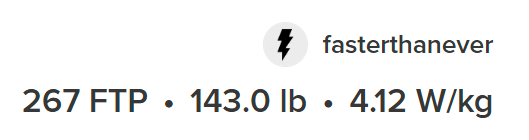
After the the ride (consistent with how I always weigh myself), I came in at 144.4 pounds, or slightly higher than my Zwift weight of 143 pounds. Using my actual weight, 4W/kg = 261.8 watts.

Doing 266 watts for 48 minutes, I got these FTP projections, all of which are above the 262W threshold.

  • Intervals.icu: 264W
  • Xert 268W
  • Zwift: 263W

If I had done just 245W for another 12 minutes, I would have still surpassed 262W for one full hour. I feel comfortable saying I could have done that.

After 8 years, it’s a great achievement, but also doesn’t change anything. It’s just nice to know I was able to do it and I want to keep going and apply it in the real world.

A Legit Zwift Win?

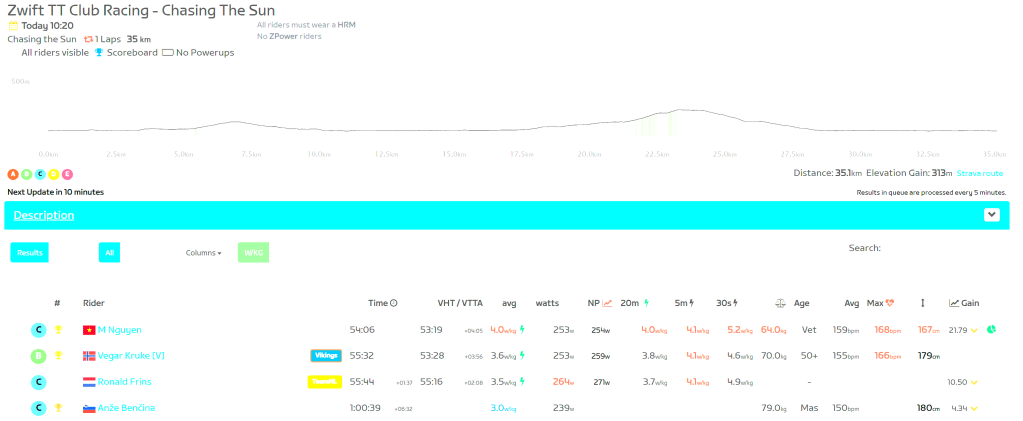
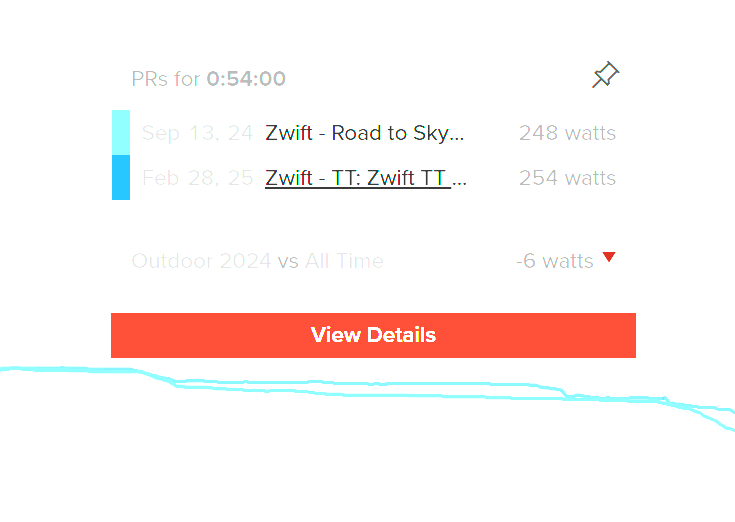
The good news: a legit Zwift victory in a time trial across all classes through a personal record of 254 watts for 54 minutes.

The bad news: My weight was underreported (I didn’t mean to cheat!). My weight post ride was 144.4 pounds, 1.6 kg / 3.5 lbs higher than reported on Zwift. My time differential was 1 minute 26 seconds so I feel like I would have won no matter what.

The big takeaway was that my power wasn’t quite my goal of 4.0 w/kg for the 54 minutes, but the still strong yet not-quite good enough 3.88 w/kg.

I’ll keep pushing.

Achieving 4W/KG: My Cycling Journey Complete?

From: Intervals.icu

I started cycling in the summer of 2016 after purchasing a used 2010 Kestrel Talon for $750. I started training at the end of that year with TrainerRoad, and ever since it’s been a long path towards a single metric of performance: 4W/KG. I hit 3W/KG within a couple of months and hoped I could 4W/KG within a couple of years.

Those years became 8, at least according to estimates from Intervals.icu with eFTP and TrainerRoad with AIFTP.

To understand the full context, FTP stands for Functional Threshold Power for cyclists. It’s a measure of your power over a sustained period of time. It’s supposed to be the max power you can make for one complete hour, but if you can imagine, it’s quite mentally and physically challenging to go 100% for that long, so many people like to use 95% of one’s maximum 20 minute power.

From: TrainerRoad

Sometimes, even 20 minutes can be too long, or perhaps you do really good power for 30 minutes, but didn’t try to maximize the 20. How do you calculate FTP then? In recent years, there have been a number of methods to try to calculate it based on your best power for X amount of time. And from these methods, I have been told that I have hit 4W/KG.

I don’t quite believe it myself. A few days ago, I hit 251W (avg) for 47 minutes. It wasn’t the best day for me, but I think if I were well rested, I could hit 255W. Could I have extended that further, to say 50, 55, or 60 minutes? Perhaps.

If I could do my projected power close to one hour, I’ll definitely be able to achieve my goal 1 hour mark at Mt Diablo. The only thing to do now is to keep training and see if I can push my high power for longer. I need something close to one hour at 260W to believe I truly hit 4W/HR. As a mid-40’s cyclist, I know my time to maintain such fitness becomes harder and harder.