

After I got injured this past July, I decided to change things with my training. I had gotten a bit bored with my outdoor riding and I found my indoor sessions a bit stressful as well. I’ve long tried to do 3 sessions totaling 4-5 hours a week and work really hard in those sessions to maximize the limited time, but over the long term I would always find myself getting frustrated and couldn’t enjoy them.
Now, I’ve decided to try my own formula of polarized training.
“Polarized training is a training approach that focuses on scaling down moderate-intensity running to emphasize easy and hard efforts. This approach emerged from research on elite endurance athletes and has been widely adopted by coaches and athletes.”
Basically this means training at the extremes, either really easy or really hard, generally following an 80% (easy) / 20% (hard) structure. There are more total hours involved, but since most of the work is easy, your body doesn’t feel overwhelmed in recovery. This is how pro cyclists train. I was always hesitant to try this because I don’t have 15+ hours to train each week, and I don’t like the type of hard workouts you’re supposed to do, VO2 Max and Threshold intervals. I don’t mind working, I just hate the mental focus required in intervals. For example, it can be easier for me to try threshold-level [power in huge chunks (30+ minutes) than a series of intervals. What I’ve decided to do this time is replace those typical hard efforts with Zwift racing, in which I’ll go as hard as I can to win races and improve my race results.
Depending on the Zwift race, this will likely look like 30 minutes to one hour of .95+ IF (95% normalized power of my theoretical 1 hour power) riding. I’ll do races on Monday and Fridays, and do my Zone 2 riding in between. What’s really nice is that Zwift now has Zwift Racing Score to help riders race against people of the same level. It’s no longer just 4 classes – I was in Class B since 2017 and raced over 200 times without getting close to a victory. Since my restart of indoor riding last in August, I’ve won three times. I don’t necessarily need to win to feel good, but knowing I could win occasionally makes things more fun. As I keep going up in score, perhaps I’ll return to the old normal of always being in the middle of the pack, but for now things feel better.
The goal of polarized training is to help you put in as much work possible to develop your fitness sustainably. If you do an intense workout that knocks you out physically or mentally for the following 3 days, you can’t make consistent progress.
Here’s the breakdown:
- 5 sessions per week – 8 hours in Zone 2, 1-1.5 hours of Zwift racing / time trial efforts.
- Zone 2 level rides: 65% to 70% of max heart rate. Try to increase power while staying in Zone 2 over time.
- 5000 calories burned per week, 1000 per day.
- 400 TSS per week.
- 5 week cycle: 4 weeks of polarized training, followed by 1 rest week of 3 days of riding – 1 Zwift race and 2 one hour Zone 2 rides, followed by 4 days of rest.
In this structure, the races give me something fun to look forward to at the beginning and end of each week. With the low stress Zone 2 riding, I can switch between watching tv, checking work messages, and listening to music so I don’t get too bored. I simply ride around the Zwift world but don’t follow a specific workout. Instead, I monitor my heart rate, calories, and normalized power for the ride, and keep those within the guidelines I set for myself.
After the 4 weeks of training, I’ll take a rest week and do a FTP test after the time off to benchmark my performance.
My Goals
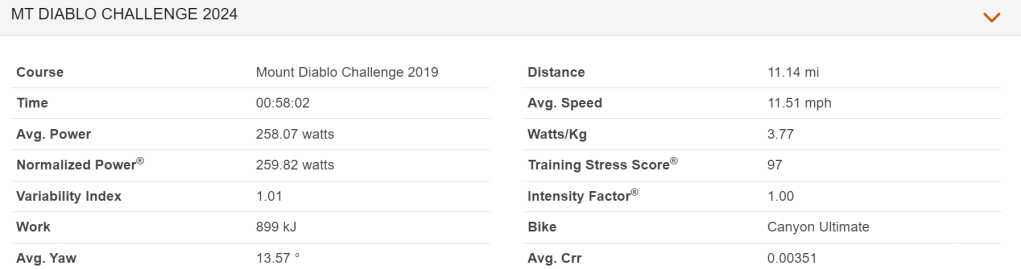
I would like to grow stronger than ever, hitting 4 w/kg in FPT. I’ve been trying to hit those goal for the last 7 years after getting to 3.5 w/kg in just a year. My FPT now is likely in the 250-260 watt range. As a percentage, I’m only looking for a 5-8% jump in power. But it’s really hard. Once I achieve this, I will firmly be in the top 10% of training cyclists.
As part of training 9-10 hours a week, I hope to sustain more power for longer once event season comes along. This year, I was able to hold .7 IF for 6-7 hours by being more steady in those rides, less volatility in power. I’d love to boost that to .75. IF, an increase of 10-15 watts for the duration of the ride.
My Progress and Impression
So far I have finished two five week cycles. Here’s how I’ve been feeling:
- I take weekends off and come in Mondays feeling strong.
- Even at the lighter Zone 2 intensity I find myself feeling tired throughout the day, sometimes in the legs, but generally feel OK the next day for another Zone 2 ride.
- Lower cadence (80 rpm) allows me to push a lot more power at the same heart rate than higher (95 rpm) cadence. But I definitely feel more muscle stress during and after the ride. I’d like to fluctuate between both so I can practice for different types of terrain in the real world.






 I Spit Hot Fire