
Progress in Training for the Mt Diablo Challenge

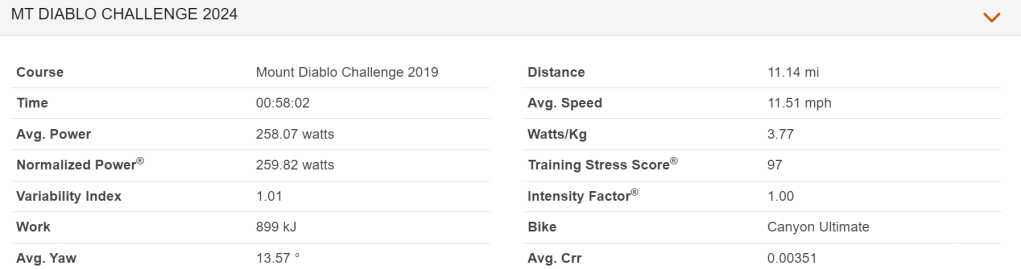
This morning, I just finished another week of training for the Mt. Diablo Challenge. There are two more weeks of building fitness and one week of recovery before the race. I finished this week with 442 TSS and 5240 calories burned, a bit over my targets.

What I have been most worried about is keeping power for an hour, the duration of the race, especially via the lower cadences used in climbing, but today I got a huge sign I am on track.

I took on Alpe du Zwift in….Zwift and achieved my second fastest time ever. I finished in 52:18, 5 seconds slower than my time on March 29, 2020, 4.5 years ago. The time is even more impressive considering my Stages SB20 trainer blanked out (it loses all friction) and I had to get it going again mid-way. Zwift reports this as 52:16 moving time, so at least a few seconds were lost in which the trainer reported 0 watts and the Zwift avatar stopped moving. I achieved this time despite coming in a bit tired from the week’s workouts, so I have optimism that this result can serve as a floor for my race performance.

I also did the ride without any taking any liquids, just as I want to do on race day.

Back in 2020, my best time was achieved in the early days of COVID when I was certain I was about a month away from my long-time goal of reaching 4w/kg. However, within the next two months, our family bought a house and moved across state lines and my fitness left as well.

More on 2020 vs 2024:

  • 81 vs 78 cadence – as I was closing on the final segment of the climb, I knew I had more in me so I spent most of it out the saddle. Overall, I didn’t abuse going out of the saddle until the final 5 minutes. I focused on doing 20 seconds out of the saddle every 3 minutes to make sure I was simulating the way I expected to ride on race day.
  • 164 vs 159 average heart rate – this suggests I had more in the tank but the counterpoint is that I’m also a half decade older so the heart rates could be equivalent. But I believe I can max out at 165 over an hour when I am feeling good.
  • 251 vs 250 average power in watts.

Moving forward, I want to do the same simulated climb at the end of the next two weeks, raising my power to 255 next week and then try for 260 the final week if 255 goes well. Overall, my plan to prepare is going well. I’m eating well but I haven’t achieved the sleep I want. Tracking my sleep has made me improve when I stop my day but I am not consistently hitting my 10:45 in bed cut-off time yet.

During my Zone two training rides, I’m going to start watching videos like this, running 80 cadence to practice the length and visual memory of the route. I have no idea if this will help come race day, but I might as well try.

This is the Way -> Mt Diablo Under One Hour

It’s time. Another Mt. Diablo Hill Climb Challenge comes in 4 weeks. A year ago I was optimistic I could finish the hill climb under 1 hour and earn myself a prized shirt. Instead, I made an error by riding 100 miles at my highest all-time intensity for that duration and couldn’t sustain enough power the next morning for the hill climb.

I had a good experience overall but wondered what could have been. In the year since, I’ve trained fairly steadily despite welcoming a new daughter into the world. I didn’t quite make the progress that I wanted, however, and I came into last weekend thinking I would take a FPT test to see where I stood and whether I could really match up with my fitness from last year.

I rode Zwift’s The Grade, and ended up with an estimated FTP of 261 watts per Intervals.icu after doing 280 watts for 13+ minutes. Last year, I did 270 watts for 27+ minutes for an estimated FTP of 263, so it feels like I’m on par with last year’s fitness.

Based on this ride profile from BestBikeSplit, the challenge is whether I can actually sustain my FTP for one hour. This rider plan is asking me for 258w average power to finish in 58 minutes, basically the same as my eFTP.

What I need to train for over the coming weeks:

  1. Do I have the longevity/focus to sustain power for an hour?
  2. Can I generate higher power at a lower cadence (65-80 RPM) for that time period?
  3. Can I lose a few pounds without losing power to improve my odds at reaching my goal?

On the first question, I have been in polarized training, with 8+ hrs of zone 2 indoor riding each week, for the past 6 weeks. I bookend those sessions with two high intensity Zwift racing sessions of 30-45 minutes. This ends up looking like 400 TSS and 5000 calories burned each week. Since school season has started for my kids, I’ll add a 30 minute commuter ride each morning in which I bike them to school with a trailer. I won’t measure this physical impact, it will just be a bonus. What I need now is to practice one extended climb at high intensity each week, Alpe Du Zwift. In the past, this climb would take me between 53-56 minutes depending on my fitness, a perfect simulation for race day.

On the second question, I have noticed that it’s difficult for me to go 260+ watts seated now. I used to do extended climbs from 70-75 cadence easily, but that’s gone. I can’t deliver that power at above 80 cadence either. When I did my FTP test, I had numerous bursts of climbing out of the saddle. Typically, I can’t stay out of the saddle for very long without feeling overly exerted, and yet this time I just wanted to stay out of the saddle. This seems to signal that my fitness is pretty good but that I also need to practice lower cadence riding. Over the last year, I have focused most of my time on aerobic higher cadence (90+) workouts. Over the coming weeks, I want to spend at least a few hours at lower cadence (70-75) each week, not including my climb practices.

On the final question, nutrition has always been tricky for me. Do I take in nutrition during the ride? Or just pre-ride? How much protein do I take? Should I listen to my body and eat when hungry? Over the past years, clear patterns have emerged. If I train, I gain weight. I don’t get leaner, however. My percentage of body fat stays the same or increases. Gaining weight means I eat too much, period. Over the next month, I’m going to execute the following:

  • Nothing outside of water after dinner (this usually ends by 6PM).
  • Be a little hungry each night.
  • Have a good carb loaded breakfast of sugary cereal and a banana each morning when I have a workout planned. Couple that with a 30G protein shake.
  • Use Gatorade Zero tablets instead of optimized sports drinks with high sugar. This along with my long bouts of Zone 2 will emphasize fat burning.
  • Stay low-carb (or couple high carbs with high fiber) for my other meals and focus on eating normal portions. Eat 1 pound of broccoli at least 5 times per week. Don’t overly focus on getting “enough” protein.
  • If I start to feel too hungry at night, make the breakfast sizes larger so they go directly into fueling the workout.
  • Don’t weigh myself until race day.
  • On race day morning, and the dinner before race day, I’ll load myself up with good carbs – fruits, high fiber pastas.
  • Focus on the process – eating leaner, good workouts, more endurance during extended climbing.

Wish me luck!

I Finally Won – “Cheating” My Way to a Zwift Victory

This morning, I won my first Zwift race! And to be honest, it wasn’t really close.

After more than 5 years of fluctuating between 3.5 w/kg and 4 w/kg, and never getting close to a B class win on Zwift, I’ll take it. Normally, winning a lower class would be called sandbagging. This is slightly different, I think. I’ve been off Zwift for close to 4 months and have been recently recovering from painful cycling injury.

Since my layoff, Zwift released its new Zwift Racing Score and reset its recommendations for riders. Or at least reset them for me. When I got back on Zwift last week, I got recommended E class. So I took it. I didn’t even podium that one. If you compare my performance in the first race to today, I worked harder (higher heart rate) in the first race, but did 13% more power (this is a lot in cycling) this morning – I was still a bit weak and a bit sick then. I didn’t even win the second race I did, in which I got recommended class D. I finished fourth – my indoor trainer went crazy and I had no power data for 15-30 seconds in the last few minutes of the race. I had expected to podium, but not win – I made the wrong call not to follow someone and my group wouldn’t work to catch up to that breakaway rider.

So again, it’s not like I’ve been destroying the competition taking easy wins.

Today though, I was feeling reasonably decent and when a gap opened up even though I wasn’t working at my limits, I decided to keep pushing and try to stay away from everyone else. It worked and the result was a 45 second victory in the field of 18, pushing about 3.6w/kg in Normalized Power (NP) for half an hour.

Zwift isn’t going to let me compete in C again, so at least I got one victory to show I don’t belong in C.

Why do we fall? To learn to pick ourselves up (2024 MCBC Dirt Fondo)

“All Dirt Fondo routes are planned with mountain and gravel bikes in mind. Upright bars and suspension will have advantages on the trails and rutted fire road segments, but a gravel bike is great for the smoother fire road bits and road segments. Either way, be prepared for some challenges along the way and walk tough sections if it looks too difficult – no one will judge you!” 2024 Dirt Fondo in Marin, CA.

Unfortunately, I took a hard fall last Saturday at the Dirt Fondo. I flipped on the bike riding a heavy rock garden-esque descent, landing primarily on my right leg around the knee. If you look at the images in the link, my descent was comparatively much rockier and chopped up – imagine pieces of large rock. I later realized I took some impact on my hands (I assumed I tried to brace myself), right forearm and left leg as well. The shock was immediate. I couldn’t move for a while and my right leg just shook uncontrollably. I had a small 1inch diameter cut below the knee which didn’t look bad but I immediately thought, what if I broke my leg?

I was fortunate that a pair of riders was right behind me and saw the crash. They helped make sure I was ok and went back to the previous rest stop to ask for help before moving on. I waited a bit, but when it didn’t seem like help was coming, I decided to continue downhill to make the next rest stop and get help there. Unfortunately, I never saw another rest stop but I did hear from another rider that I was being searched for and I was able to send an update via a volunteer. I rode through more gravel/dirt/rock sections before taking a detour and finding pavement as I rode through beautiful Sausalito back to the start – another 2 hrs of riding after the fall.

  • Should I have picked a different path? This is probably the critical issue. Going down, the edge of the mountain was on the left. I am guessing a 10 foot wide path total split into two. On the left edge is a loose (smaller) rock path, on the right is a rock garden-ish path. I don’t remember exactly why I took the right, but here are a few notes I’ve reflected uplon. There was someone going up hill on my left. Did I see that person before picking the right side? I’m not sure but that would have been a reason to go right, there wasn’t room. Loose rock is very slippery, and because that was the mountain edge side, I may not have wanted to be struggling with slowing down on slippery rock. As I started descending perhaps I wanted to move to the loose rock, but that would have been very scary to attempt. I kind of knew the rock descent was difficult but the decision would have been to focus on surviving, not attempting a tricky transition.
  • Should I have run different (wider) tires? I ran pretty wide tires for gravel, 42mm S-Works Pathfinders that expanded to 47.2mm on my wheels. MTB tires can be 10-20 mm wider but after I fell, I saw other gravel bike riders (who took the other smaller rock line) on thinner tires.
  • Should I have run lower tire pressure? Anything can be second guessed. I was running 22/23 PSI on my tires, which I feel is pretty low. The pair behind me were running wider MTB tires and suspension bikes. Less air would have meant a softer ride but I don’t think that was the culprit.
  • Should I have gone slower or faster? On unpaved terrain, I have learned that going faster is often better than going slower because speed helps you roll over obstacles better. I don’t think I was going fast at all, most likely less than 8 mph. It’s hard for me to remember because it was a descent, I was for sure braking or in a brake position in the drops and I was in a rocky path in which I was just trying to go over big rocks non-stop. I didn’t want to go too fast because I didn’t have good traction but going too slow would stop the bike because of the rocks.
  • What was my position on the bike? Earlier, I mentioned I flipped over the bike. I don’t think that’s accurate. I didn’t land on my head. I think the bike got stopped on a rock and I had to fall over in the process. I don’t think I was front leaning on the bike, but I’m not sure if I was sitting or in a more crouched/standing position on the saddle.

Sitting down, writing this a couple of days later, I of course want to blame the event a bit. If I’m the only one who fell (I do not know if this is the case), then I have to assume it’s my fault, whether that be due to lack of skill, bad luck, or something else.

As for my injury, I learned I haven’t broken anything, or at least nothing that can be seen on X-Ray. That’s good news so far. The bad news is that I couldn’t walk the day after the event because of the swelling in my leg. Thankfully, my body let me ride and drive home on the event day – I was 1.5 hrs driving away from home.

I feel a lot better two days after the accident (if not a bit tired) and remain hopeful I just need time to heal. I can’t walk unsupported yet.